Couple therapy vs family counseling comparison illustration.

Couple Therapy vs. Family Counseling: What’s the Difference and Which One Do You Need?

If you’re trying to figure out whether you need couple therapy or family counseling, you’re not alone — and the confusion is understandable. They sound similar. They’re both relational. But they serve different people, address different problems, and work in meaningfully different ways. This guide explains the difference clearly so you can find the right starting point.

What Is Couple Therapy?

Couple therapy is a form of psychotherapy focused specifically on the two-person romantic relationship. The unit of care is the partnership itself not either individual in isolation, and not the broader family system.

It’s designed for partners who are struggling with what’s happening between them: the patterns that repeat, the distance that’s grown, the trust that’s been damaged, or the connection that’s quietly gone missing.

What Couple Therapy Actually Addresses

Couple therapy session addressing communication, trust, and relationship challenges.

  • Recurring arguments that circle the same ground without resolution
  • Emotional distance or disconnection between partners
  • Infidelity and rebuilding trust after a breach
  • Communication breakdown — where conversations either escalate or shut down
  • Divorce discernment — when one or both partners aren’t sure whether to stay
  • Life transitions that have shifted the dynamic: new parenthood, career changes, relocation
  • Intimacy challenges — emotional, physical, or both

Research shows that nearly 90% of people who complete couples counseling report improvement in their emotional wellbeing, and over 75% report greater relationship satisfaction. And here’s what surprises most people: couple therapy produces positive outcomes even in cases where the relationship ultimately ends — because the goal was never just to keep two people together. It was to help them understand each other, and themselves, more clearly.

Techniques Used in Couple Therapy

  • The Gottman Method focuses on conflict resolution, friendship, and shared meaning — particularly effective when arguments feel circular or trust has been damaged
  • Emotion-Focused Therapy (EFT) helps partners understand the attachment patterns beneath their conflicts — the fear, withdrawal, and pursuit cycles that keep repeating even when both people want things to be different
  • Behavioral Couples Therapy (BCT) works on reinforcing positive patterns and reducing the negative behaviors that create distance and resentment over time

Also Read: Is It Love or Obligation?

What Is Family Counseling?

What Is Family Therapy? Family counseling is a form of therapy that brings in the broader household—parents, children, and sometimes extended family members—to address how the family system as a whole is functioning. The central premise is that no one person’s behavior happens in isolation. The way a family communicates, what’s allowed to be said, what gets buried, and who carries what all create a system. When that system is under enough stress, it shows up in everyone. Sometimes it shows up most visibly in the person least equipped to hide it. 

What Family Counseling Actually Addresses
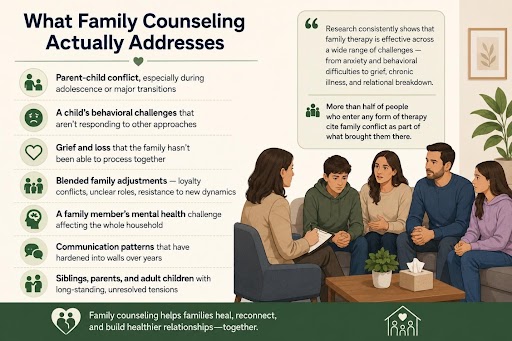
Family counseling session illustrating common family challenges and healing through therapy

  • Parent-child conflict, especially during adolescence or major transitions
  • A child’s behavioral challenges that aren’t responding to other approaches
  • Grief and loss that the family hasn’t been able to process together
  • Blended family adjustments — loyalty conflicts, unclear roles, resistance to new dynamics
  • A family member’s mental health challenge affecting the whole household
  • Communication patterns that have hardened into walls over years
  • Siblings, parents, and adult children with long-standing, unresolved tensions

Research consistently shows that family therapy is effective across a wide range of challenges — from anxiety and behavioral difficulties to grief, chronic illness, and relational breakdown. More than half of people who enter any form of therapy cite family conflict as part of what brought them there.

Techniques Used in Family Counseling

  • Structural Family Therapy examines the boundaries, roles, and power dynamics within the family unit — and works to reshape them into something healthier
  • Systemic Family Therapy looks at how the family functions within broader contexts: cultural background, social pressures, community ties, and generational patterns
  • Functional Family Therapy (FFT) is particularly useful when children are struggling with behavioral issues — it assesses family dynamics and builds communication and parenting skills

Also Read: What Is Family Therapy, And How Can It Help Your Family?

The Core Difference Between Couple Therapy and Family Counseling

The clearest way to understand the difference is this: it comes down to who the therapy is designed to serve, and where the pain is primarily located.

Couple therapy focuses on the two-person romantic dynamic. The therapist works with the partnership — the communication between partners, the trust or lack of it, the emotional distance, and the patterns that repeat regardless of how much both people want things to change.

Family counseling focuses on the household system. It’s not about one person’s problem or one couple’s conflict. It’s about the patterns everyone is living inside — how roles get assigned, how communication flows or breaks down, and how stress in one part of the family ripples through all of it.

Here’s a direct comparison:

  • Unit of care: Couple therapy = two partners. Family counseling = the household as a system.
  • Primary focus: Couple therapy = romantic relationship, intimacy, communication, trust. Family counseling = family roles, boundaries, multi-member dynamics.
  • Common issues: Couple therapy = infidelity, recurring conflict, emotional detachment, divorce discernment. Family counseling = parent-child conflict, grief, blended family challenges, behavioral issues.
  • Techniques: Couple therapy = Gottman Method, EFT, BCT. Family counseling = Structural, Systemic, and Functional Family Therapy.

When Couple Therapy and Family Counseling Overlap

These two approaches are distinct — but they often intersect in real life. And that’s worth knowing before you choose.

A couple may begin couple therapy to work through a marital issue. If that issue is affecting the children, creating tension throughout the household, or leading toward divorce, the focus naturally expands to include the whole family. A therapist skilled in both can help you navigate that transition without starting over from scratch.

Similarly, a family may enter family counseling with what looks like a child’s behavioral problem — only to discover that the root of it is unresolved tension between the parents. In that case, a period of couple therapy alongside or after family work may be what actually produces change.

In our experience working with families across cultures and life situations, the cleanest outcomes usually come from starting with the most pressing pain point, and letting the work reveal what else needs attention.

Does Couple Therapy Online Work as Well as In-Person?

Yes. A 2024 study following 490 participants found no meaningful difference in outcomes between online and in-person couples therapy. Some couples find it easier, actually — being in their own space lowers the guard just enough to have the conversations that matter.

How to Choose: Which One Is Right for You?

You don’t need to have this figured out before you reach out. Helping you understand what kind of support fits your situation is part of what a therapist does. But if you’re trying to make sense of it tonight:

  • If the pain is between you and your partner — the communication, the trust, the recurring arguments, the emotional distance — couple therapy is where the work is
  • If the pain has spread across the whole household — if it’s in the air at home, if everyone is feeling it even if nobody’s talking about it — family counseling is built for that
  • If you’re not sure whether it’s a couple issue or a family issue — say that. A good therapist won’t make you feel foolish for not knowing. They’ll help you find out.

And if something feels internal — more about you than about anyone else — that’s when individual therapy is the right starting point, before or alongside relational work.

Frequently Asked Questions

What is the main difference between couple therapy and family counseling?

Couple therapy focuses on the romantic relationship between two partners — communication, trust, intimacy, and recurring conflict. Family counseling addresses the broader household dynamic, bringing in children or other family members to work on patterns that affect everyone. The key distinction is the unit of care: couple therapy centers the partnership; family counseling centers the family system.

Can we do couple therapy and family counseling at the same time?

Yes, and in many cases it makes sense to. A couple working through marital issues may also benefit from family sessions if those issues are affecting the children. A therapist experienced in both can help coordinate the work so nothing gets duplicated and both sets of needs are addressed.

What techniques do couple therapists use?

The most widely used approaches are the Gottman Method — which focuses on conflict resolution, friendship, and shared meaning — and Emotion-Focused Therapy (EFT), which helps partners understand and shift the attachment patterns beneath their conflicts. Behavioral Couples Therapy (BCT) is also commonly used to reinforce positive patterns and reduce behaviors that create distance over time.

What techniques do family counselors use?

Family therapists commonly draw on Structural Family Therapy, which examines and reshapes boundaries and roles within the household, and Systemic Family Therapy, which considers how broader cultural and social contexts shape the way a family functions. Functional Family Therapy (FFT) is particularly useful when children are dealing with behavioral challenges.

Is online couple therapy as effective as in-person?

Yes. Research, including a 2024 study of 490 participants, found no meaningful difference in outcomes between online and in-person couples therapy. Many couples find the online format easier to commit to consistently — and consistency is one of the strongest predictors of good outcomes in therapy.

How do I know if my family needs family counseling or if one person needs individual therapy?

If the challenges seem to belong to one specific person — their mental health, their history, their internal experience — individual therapy is usually the right starting point. If the challenges are relational — how family members interact, communicate, or affect each other — family counseling addresses the root more directly. Often, both are helpful at different points, and one tends to inform the other.

Therapy in Rhode Island and Online — We’re Here When You’re Ready

Whether what you’re facing lives between you and your partner, or in the wider space of your family, the right support makes a real difference. At Integrated Counseling Service, we work with couples and families across a wide range of situations — and we meet you where you are, not where you think you’re supposed to be.

Dr. Noreen Shaffi has worked with individuals, couples, and families for more than 15 years — more than 25,000 sessions across cultures, countries, and life situations. Her approach is warm, direct, and grounded in your specific reality.

Couple therapy, family counseling, and individual therapy are available in Pawtucket, Rhode Island, and online across Massachusetts, Texas, and beyond. You don’t need to have the right words when you reach out. You just have to reach out.

Read More
Confused man offering a ring to an unhappy woman during a relationship conflict

Is It Love or Obligation?

Understanding Guilt in Family Relationships

Why this question feels uncomfortable to even ask

Most people don’t sit down and clearly think, “I feel obligated to my family.”

What they feel is something more tangled.

They feel guilty for not calling enough.
Guilty for wanting space.
Guilty for feeling irritated when they “should” feel grateful.

And underneath all of that is a quieter, more uncomfortable thought:

If I love them, why does this feel like pressure?

That’s where the confusion begins. Because in many families, love and obligation are so closely tied together that separating them can feel almost disloyal.

When love starts to feel heavy

Healthy love has a certain quality to it. It allows closeness, but it also allows space. It doesn’t require you to constantly prove your care through sacrifice.

Obligation feels different.

It shows up as a sense that you should do something, even when you’re emotionally exhausted. It makes relationships feel like responsibilities you have to manage rather than connections you can return to.

The tricky part is that obligation often disguises itself as love.

You tell yourself, “I’m doing this because I care.”
But if you pause and look closely, the emotion underneath might not be warmth. It might be anxiety, guilt, or fear of disappointing someone.

That doesn’t mean there’s no love. It just means something else has become attached to it.

A simple way to tell the difference

Instead of trying to analyze the relationship as a whole, it helps to look at your internal response in specific moments.

Think about the last time your family asked something of you.

Did it feel like a choice you were willing to make, even if it required effort? Or did it feel like something you couldn’t really say no to, even if you wanted to?

Love usually allows for choice. Even when you say yes, it feels like your decision.

Obligation removes that sense of choice. You may still say yes, but it feels like you had no real alternative.

That distinction matters more than the action itself.

Where the guilt comes from

Guilt in family relationships doesn’t come out of nowhere. It’s usually learned, slowly and subtly.

In many families, approval is tied to compliance. Being “good” means being accommodating, respectful, and available. Over time, this creates an internal rule:

If I don’t meet expectations, I’m letting someone down.

That rule doesn’t disappear when you grow up. It just becomes quieter and more internal.

So even when no one is directly asking anything unreasonable, you still feel responsible. You anticipate reactions. You manage emotions that may not even be expressed.

This is why guilt can show up even in relatively calm families. It’s not always about what is happening now. It’s about what you’ve learned to expect.

How this plays out in everyday situations

This dynamic shows up in ways people often overlook.

You agree to plans even when you need rest, and then feel resentful afterward. You avoid difficult conversations because you don’t want to upset anyone. You find yourself explaining or justifying decisions that don’t actually require approval.

Over time, this creates a pattern where your needs become secondary, not because they don’t matter, but because they feel harder to prioritize.

In relationships, this can also spill over. Many couples struggle not just with each other, but with the expectations that come from their families. It’s not uncommon for people to seek online couples counseling when the tension isn’t only between partners, but between the relationship and the family system around it.

Why “just set boundaries” doesn’t always work

Advice around boundaries is everywhere, and while it’s useful, it often misses something important.

Setting a boundary with a stranger is very different from setting one with family.

With family, you’re not just dealing with the present moment. You’re dealing with history, roles, expectations, and emotional patterns that have developed over years.

So when someone tries to set a boundary, the difficulty isn’t just in saying the words. It’s in managing what follows.

The guilt.
The second-guessing.
The fear that you’ve damaged the relationship.

This is why many people understand boundaries intellectually, but struggle to apply them consistently.

A more realistic way to approach it

Instead of trying to eliminate guilt completely, it can be more helpful to change how you respond to it.

Feeling guilty doesn’t automatically mean you’ve done something wrong. Sometimes it simply means you’re doing something differently than you’re used to.

Start by noticing when guilt shows up, and ask a different question:

Is this guilt coming from harming someone, or from not meeting an expectation?

Those are not the same thing.

If your actions are respectful but still uncomfortable for others, that discomfort does not automatically mean you’ve made the wrong choice.

When it starts affecting your well-being

There’s a point where this pattern moves beyond occasional discomfort and starts affecting your mental health.

You may feel constantly responsible for how others feel. You may struggle to relax because you’re always anticipating what’s expected of you next. You may feel emotionally drained after interactions that are supposed to feel supportive.

This is often when people begin exploring therapy for family conflicts, not because they don’t care about their family, but because they care enough to want a healthier way of relating.

In many cases, family therapy online can help unpack these patterns in a structured way, especially when direct conversations feel difficult or overwhelming.

What changes when you separate love from obligation

One of the most important shifts is this:

You stop measuring love by how much you sacrifice.

Instead, you begin to measure it by how honest and sustainable the relationship feels.

When obligation is reduced, something interesting happens. The resentment starts to fade. The interactions that remain begin to feel more genuine, not because you’re doing more, but because what you’re doing feels chosen.

This doesn’t mean relationships become perfect or conflict-free. It means they become more balanced.

A question worth sitting with

If you’re unsure where you stand, consider this:

If guilt wasn’t part of the equation, what would change about how you show up in this relationship?

That question can be uncomfortable, but it’s also clarifying.

Because the goal isn’t to love less. It’s to relate in a way that doesn’t require you to constantly override yourself.

What to take with you

You don’t have to reject your family to question certain patterns within it. You don’t have to choose between caring about others and caring about yourself.

Sometimes, the work is simply noticing where love ends and obligation begins.

And once you can see that clearly, you have more choice in how you respond.

If you find yourself stuck in that space, where every choice feels loaded with guilt, talking to someone outside the dynamic can help you see it more clearly. Whether through therapy for family conflicts or structured support like online couples counseling, the goal isn’t to distance you from your relationships, but to help you experience them with less pressure and more clarity.

Because love, at its healthiest, doesn’t feel like something you’re constantly trying to get right. It feels like something you can actually live inside.

Personalized one-on-one support for stress, anxiety, depression, trauma, and other mental health challenges. Our counselors in RI have helped individuals, couples, and families through more than 25,000 counseling sessions with compassionate, practical guidance tailored to each person’s unique circumstances.

Healthy relationships begin with understanding yourself. Whether you’re learning to set boundaries, overcome unhealthy patterns, or find greater emotional balance, working with the best therapists in RI can help you recognize the difference between love and obligation, empowering you to make choices that support your well-being.


Read More
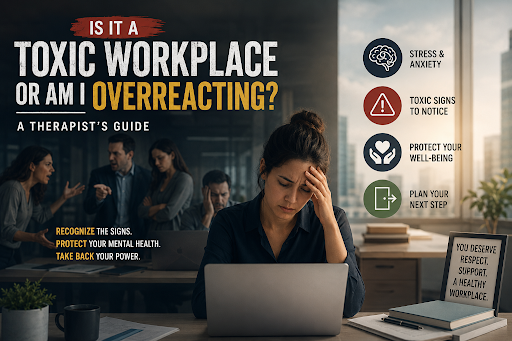
Illustration of a toxic workplace affecting employee well-being.

Is It a Toxic Workplace or Am I Overreacting?

If you’ve been asking yourself this question, you’re not alone — and the fact that you’re asking it matters. Most people don’t start by questioning their workplace. They start by questioning themselves. This guide helps you understand what a toxic workplace actually looks like, why it’s so hard to recognize, and what you can do about it.

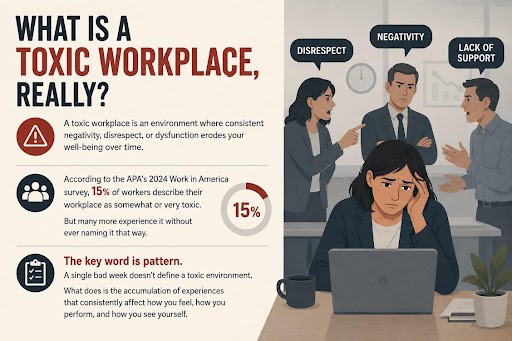
What Is a Toxic Workplace, Really?

Signs You May Be in a Toxic Workplace

Toxic workplaces don’t always look the same. Some are loud and obvious. Others are quiet and cumulative. Both are real, and both cause harm.

Subtle Signs That Are Easy to Dismiss

  • You feel anxious before work or dread Mondays in a way that didn’t used to be true
  • You second-guess decisions that would have felt straightforward before
  • You hold back in meetings or avoid contributing, even when you have something to say
  • Expectations shift frequently, and you can’t seem to figure out how to meet them
  • You spend more energy managing the environment than doing your actual job

A toxic workplace is an environment where consistent negativity, disrespect, or dysfunction erodes your well-being over time. It’s not just a stressful job or a demanding boss. It’s a pattern — one that leaves you feeling unsafe, uncertain, or diminished on a regular basis.

According to the APA’s 2024 Work in America survey, 15% of workers describe their workplace as somewhat or very toxic. But many more experience it without ever naming it that way.

The key word is pattern. A single bad week doesn’t define a toxic environment. What does is the accumulation of experiences that consistently affect how you feel, how you perform, and how you see yourself.

Why You Question Yourself First

Most people don’t start by questioning the workplace. They start by questioning themselves. They notice they feel more anxious before meetings than they used to. They replay small interactions long after the workday ends. They hesitate before speaking up, even in situations where they would normally feel comfortable.

And then almost immediately, they try to explain it away. “Maybe I’m overthinking this. Maybe I’ve just become more sensitive.”

The Habit of Explaining It Away

That instinct is understandable. Most people have been taught to push through discomfort rather than analyze it. Work is not supposed to feel easy all the time, and there’s often pressure — internal and external — to keep going without complaint.

The problem is that this habit makes it harder to recognize when the discomfort isn’t just part of the job. In many cases, what feels like personal sensitivity is actually a reaction to a workplace issue that hasn’t been clearly identified yet.

You are not overreacting. You are responding. And that response is worth paying attention to.

Also Read: Is It Love or Obligation?

Healthy Work Pressure vs. a Toxic Environment: What’s the Difference?

A demanding job can take a lot out of you. But it usually makes sense. You understand why you feel tired. There are deadlines, expectations, and responsibilities that require real effort — and even when it’s difficult, there’s a certain clarity to it.

What tends to feel different in a harmful environment isn’t just the level of pressure. It’s the type of impact it has on you.

Here’s a practical way to tell them apart:

  • Healthy pressure challenges your capacity. You feel stretched, but you understand what’s expected. Feedback is consistent enough to learn from.
  • A toxic environment affects your stability and self-trust. Expectations shift without warning. Feedback feels contradictory. You spend more time interpreting people than actually doing your work.

The clearest signal? In a healthy setting, effort leads to some form of clarity or recognition. In a toxic one, no matter how hard you work or how carefully you communicate, things don’t improve — and often get worse.

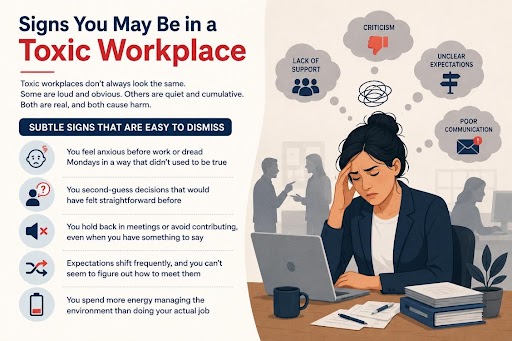
Signs You May Be in a Toxic Workplace

Employee showing stress and anxiety in a toxic workplace with common warning signs illustrated around them.

Toxic workplaces don’t always look the same. Some are loud and obvious. Others are quiet and cumulative. Both are real, and both cause harm.

Subtle Signs That Are Easy to Dismiss

  • You feel anxious before work or dread Mondays in a way that didn’t used to be true
  • You second-guess decisions that would have felt straightforward before
  • You hold back in meetings or avoid contributing, even when you have something to say
  • Expectations shift frequently, and you can’t seem to figure out how to meet them
  • You spend more energy managing the environment than doing your actual job

More Serious Patterns to Take Seriously

  • Fear-based leadership: Constant micromanagement, threats, or using fear as a management tool
  • Gaslighting: Being told your perception of events is wrong, or that you’re “too sensitive”
  • Exclusion: Being left out of conversations that directly affect your role
  • Credit theft and blame-shifting: Your work gets claimed by others; your mistakes get amplified
  • Retaliation risk: You’re afraid to speak up, set a boundary, or report a problem because of what might happen
  • High turnover: People keep leaving, and no one talks openly about why

None of these moments have to be dramatic to be serious. Workplace harassment frequently develops through repeated small patterns, not single extreme incidents. The impact comes from repetition — and over time, even subtle patterns change how comfortable and confident you feel participating at all.

If you’re struggling with stress and anxiety management, working through what you’re experiencing in a safe therapeutic space can help you separate the environmental from the internal — and respond from a clearer place.

How a Toxic Workplace Affects You Over Time

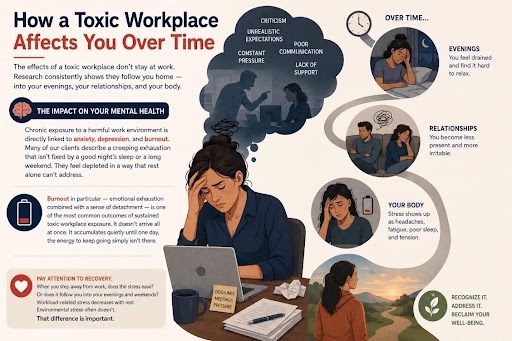
Stressed employee illustrating the long-term mental and emotional effects of a toxic workplace.

The effects of a toxic workplace don’t stay at work. Research consistently shows they follow you home — into your evenings, your relationships, and your body.

The Impact on Your Mental Health

Chronic exposure to a harmful work environment is directly linked to anxiety, depression, and burnout. Many of our clients describe a creeping exhaustion that isn’t fixed by a good night’s sleep or a long weekend. They feel depleted in a way that rest alone can’t address.

Burnout in particular — emotional exhaustion combined with a sense of detachment — is one of the most common outcomes of sustained toxic workplace exposure. It doesn’t arrive all at once. It accumulates quietly until one day, the energy to keep going simply isn’t there.

Pay attention to recovery. When you step away from work, does the stress ease? Or does it follow you into your evenings and weekends? Workload-related stress decreases with rest. Environmental stress often doesn’t. That difference is important.

The Impact on Your Sense of Self

This is the part that doesn’t always get talked about. Beyond anxiety and burnout, prolonged exposure to a toxic environment can quietly erode your confidence, your sense of competence, and your trust in your own judgment.

You may start doubting abilities that were never in question before. You may feel the need to constantly prove your value — to colleagues, to leadership, or even to yourself. Over time, the experience stops being about the work and becomes about managing the environment just to survive each day.

In our experience, this erosion of self-trust is often one of the hardest things to recover from — and one of the most important reasons to take your experience seriously before it compounds further.

Also Read: What Is Family Therapy?

What You Can Do Right Now

While You’re Still in the Job

  • Document everything. Keep a private log of specific incidents, dates, and any witnesses. This is essential if you ever need to escalate to HR or make an unemployment claim.
  • Set real boundaries. Stop answering emails outside of work hours. Don’t take on more than is humanly possible for your role. Protect your time off.
  • Build a support network outside the toxic circle. Connect with peers, friends, or a therapist who can offer perspective that isn’t colored by the environment you’re in.
  • Know your rights. If the toxicity involves illegal discrimination, harassment, or retaliation, you have legal options. Your state’s labor board and the federal EEOC are starting points.

If You’re Ready to Plan Your Exit

  • Update your resume and LinkedIn now — not after you leave
  • Reach out to trusted contacts before you need to
  • If you’re in a couple or family situation, couple therapy can help you and your partner navigate the stress of a career transition together
  • Your long-term mental and physical health is the priority. No job is worth sacrificing both.

When It’s Time to Talk to Someone

You don’t need to hit a breaking point to seek support. If your work environment is consistently leaving you feeling uncertain, diminished, or unable to show up as yourself, that is reason enough.

Therapy offers something that friends, family, and HR cannot: a structured space to untangle what’s happening, separate your reactions from the environment’s influence, and rebuild the self-trust that a toxic workplace can quietly take from you.

Many people come to us after months of trying to fix the situation themselves — adjusting how they communicate, working harder, being more careful. What they often discover in therapy is that the problem was never theirs to fix. Processing that realization, and moving forward from it, is exactly what this work is for.

If you’re ready to talk, our stress and anxiety management services are available in Rhode Island and online, and our approach is always tailored to your specific experience — not a one-size-fits-all framework.

Frequently Asked Questions

How do I know if my workplace is toxic or if I’m just stressed?

The key difference is pattern and recovery. Normal work stress tends to ease when the pressure lifts — after a deadline, over a weekend. A toxic environment follows you home and doesn’t improve even when you rest or adjust your approach. If your stress feels tied to the environment itself rather than a specific workload, that’s a meaningful signal.

Can a toxic workplace cause anxiety and depression?

Yes. Research clearly links sustained exposure to harmful work environments with anxiety, depression, burnout, and even physical health problems. Many people experience these symptoms without connecting them to their job. If you’ve noticed a significant change in your mood, energy, or self-confidence that aligns with your work situation, it’s worth taking seriously.

What should I do if I can’t afford to leave my toxic job right now?

Focus on what you can control. Set firm boundaries around your time and energy. Document incidents carefully. Build a support network outside of work. Prioritize your mental health through therapy or other self-care practices. And start quietly preparing your exit — updating your resume, connecting with your network — so that leaving becomes an option rather than an emergency.

Is workplace harassment always obvious?

No. Harassment often develops through patterns of small, individually dismissible incidents — being regularly interrupted, excluded, undermined through “jokes,” or blamed unfairly. None of these seem extreme in isolation. But the cumulative impact on your confidence and comfort is real and serious. You don’t need a single dramatic incident to take what you’re experiencing seriously.

When should I consider therapy for workplace stress?

Consider therapy when work stress is affecting your sleep, your relationships, your confidence, or your sense of self — not just your performance. You don’t need to be in crisis to benefit. A therapist can help you understand what’s happening, process the experience, and build strategies for protecting your well-being whether you stay or leave.

Can toxic workplace stress affect my relationships at home?

Absolutely. Workplace trauma doesn’t stay at work. Many people find that the exhaustion, irritability, and emotional withdrawal caused by a toxic environment spills into their home life and closest relationships. Addressing the root cause — and the emotional impact — is important for your relationships as much as your career.

Support Is Available in Rhode Island and Online

If what you’ve read here resonates with you, you don’t have to navigate it alone. At Integrated Counseling Service, we work with individuals who are processing the stress, confusion, and self-doubt that a difficult work environment can create.

With more than 15 years of experience and 25,000+ sessions, our approach is warm, practical, and grounded in your specific situation — not a generic framework. We serve clients in Pawtucket, Rhode Island, and offer online therapy across Massachusetts, Texas, and beyond.

Reaching out is not a sign that you’ve failed. It’s a sign that you’re ready to stop absorbing what was never yours to carry.

Book a session for Toxic Workplace today.

Book a session for Toxic Workplace today.

Read More

Service Areas

We proudly serve multiple locations across Massachusetts and Texas.

📍 Quincy, Massachusetts
📍 Waltham, Massachusetts
📍 Newton Upper Falls, Massachusetts
📍 Lexington, Massachusetts
📍 Malden, Massachusetts
📍 Cambridge (Kendall Square), Massachusetts
📍 Hopkinton, Massachusetts
📍 Plano, Texas
📍 Frisco, Texas
📍 McKinney, Texas
📍 Garland, Texas
📍 Dallas (Oak Lawn), Texas
📍 Rockwall, Texas
📍 Little Elm, Texas
📍 Irving, Texas
📍 Houston, Texas
📍 Sugar Land, Texas
📍 Richmond, Texas
📍 Dallas, Texas