Couples therapy session for relationship growth

Benefits of Couples Therapy for Relationship Growth

The same argument keeps coming back. Conversations end before anything gets resolved. You’re sharing a home but not much else. Couples therapy helps partners understand what’s driving those patterns and build something that actually works better. 

You don’t have to be on the verge of a breakup to consider couples therapy. If something has felt off for a while and conversations aren’t fixing it, that’s already a reason to go.

Here’s what couples therapy actually does, who it’s for, and how to know if it makes sense for where you are right now.

What Is Couples Therapy?

Couples therapy is a structured process where both partners work with a licensed therapist to address the patterns affecting their relationship. 

Sessions aren’t about relitigating old arguments or deciding who’s right. They’re about understanding what’s driving the same problems and developing practical ways to handle them differently.

It’s different from individual therapy, which focuses on one person’s internal experience, and from family therapy, which brings in children or extended family when the whole family system needs support. 

Couples therapy focuses specifically on the dynamic between two people, how they communicate, how they fight, how they connect, and what gets in the way.

Key Benefits of Couples Therapy

Infographic showing key benefits of couples therapy

What actually changes in couples therapy isn’t always what people expect going in:

Better Communication Skills

Communication problems don’t always look like shouting matches. They show up as conversations that end before anything gets resolved, or topics that quietly get avoided because previous attempts felt pointless. 

Therapy teaches partners how to express what they actually need, how to listen without immediately getting defensive, and how to time difficult conversations so they don’t spiral before they start.

A Neutral Space to Work Through Conflict

At home, arguments tend to follow the same path. One person escalates, the other shuts down, and nothing actually gets addressed. 

A therapist doesn’t take sides. What they do is slow the conversation down enough that both partners can actually hear each other, something that’s surprisingly hard to do at home when the same argument has been running for months. 

Deeper Understanding of Each Other

Therapy surfaces patterns that are hard to see from inside the relationship. One partner may not realize how their tone lands during conflict. The other may not recognize that they withdraw when they feel criticized rather than saying so directly. 

Once those patterns become visible, both people are working with a clearer picture instead of reacting to what’s on the surface.

Rebuilding Trust and Intimacy

After infidelity, prolonged conflict, or emotional distance, trust doesn’t come back on its own. It requires consistent honesty, accountability, and time, but also a structured process for having the conversations that feel too charged to have without support.

Therapy creates that structure. And when the disconnection underneath gets worked through, closeness tends to come back on its own, not because it was forced, but because the thing blocking it finally got addressed.

Tools You Keep After Therapy Ends

The goal isn’t to need a therapist every time something goes wrong. It’s to leave with a clearer sense of how to handle it yourselves.

Couples who go through therapy often come out with specific communication habits, conflict repair strategies, and ways of checking in with each other that stay useful long after sessions end.

Read More Blog: Is It Love or Obligation?

Does Couples Therapy Actually Work?

Yes, and the research supports that. Studies consistently show that couples who commit to the process report measurable improvements in relationship satisfaction and communication. 

The caveat is that both partners need to be genuinely engaged; therapy doesn’t work if one person is going through the motions while the other is doing the actual work.

The more common obstacle isn’t unwillingness; it’s timing. Couples tend to wait too long. By the time they book a first session, the same arguments have been happening for years, and the emotional distance has become the default. 

Therapy works at that stage too, but it takes longer. The earlier couples go, the more options they have and the less ground they have to recover.

A lot of couples assume therapy is a last resort, something you try right before calling a lawyer. It’s not.

Couples who go proactively, before things get bad, tend to have an easier time because they’re building on something that still has momentum rather than trying to repair something that’s been strained for years.

Mental and Emotional Benefits of Couples Therapy

Couples therapy infographic showing mental and emotional benefits for healthier relationships.

Couples therapy isn’t only good for the relationship. It’s good for each person individually. Relationship stress is one of the more reliable drivers of anxiety and depression. 

When the tension at home is constant, it affects sleep, concentration, and the ability to manage stress in other areas of life. Addressing that tension in therapy often reduces symptoms that felt unrelated to the relationship.

Therapy also has a way of holding up a mirror. You start noticing how you respond when you feel criticized, why certain topics make you shut down, where your side of the dynamic is coming from.

That kind of self-knowledge doesn’t stay in the room. It carries over into how people handle conflict at work, with family, and in other relationships.

Addressing that dynamic in therapy has an effect that extends well beyond the relationship itself.

Read More Blog: What Is Family Therapy

Benefits of Couples Therapy Before Marriage

Premarital therapy isn’t a warning sign. It’s what happens when two people decide to have the harder conversations before life forces them to.

Couples who go to therapy before marriage get ahead of the conversations that tend to cause problems later: how they’ll handle finances, what their expectations are around family, how they each deal with conflict, and what intimacy looks like for each of them. These aren’t romantic topics, but they’re the ones that tend to create friction when they go unaddressed.

At Integrated Counseling Services, therapists work with couples at this stage the same way they work with couples navigating crisis, by looking at the specific dynamic between those two people rather than applying a generic framework. 

The difference is that couples who go early are working with more goodwill and fewer entrenched patterns, which makes the process faster and the outcomes easier to maintain.

Going before marriage doesn’t prevent all problems. It does mean you’ve already practiced having the hard conversations before they arrive with higher stakes attached.

Who Should Consider Therapy for Couples?

A few situations where couples therapy tends to make a real difference: 

Partners who keep having the same argument without resolution, where the topic changes but the outcome doesn’t. Couples who have drifted emotionally and aren’t sure when it started. 

Relationships recovering from a breach of trust, an affair, or a period of prolonged conflict. Partners facing a major transition: a new baby, a career change, a move, where responsibilities have shifted, and neither person is sure how to adjust. 

And couples who are doing well and want to stay that way, because waiting for a problem to appear before paying attention to the relationship is how small things become big ones.

What Are the 7-7-7 and 5-5-5 Rules in Couples Therapy?

The 7-7-7 rule is a relationship guideline suggesting couples go on a date every seven days, take a weekend away every seven weeks, and take a longer trip together every seven months. It’s not a clinical model, but the idea behind it is sound: relationships need regular investment, not just attention during a crisis.

The 5-5-5 rule is a structured communication exercise used in therapy. One partner speaks for five minutes without interruption. The other listens for five minutes without responding. The final five minutes are used to discuss what was heard. The goal isn’t to solve the problem immediately. It’s to slow the conversation down enough that both partners feel heard before any problem-solving begins.

Is Online Couples Counseling as Effective?

For couples who can’t easily get to in-person appointments because of scheduling, distance, or work commitments, online therapy is a practical alternative, not a lesser one.

Research shows that outcomes for online couples counseling are comparable to in-person sessions when both partners are engaged, and the therapist is experienced in the format.

The main advantage is accessibility. Couples are more likely to keep appointments when the barrier to showing up is lower, and consistency matters more in therapy than format.

What Couples Therapy Actually Looks Like

The first session is usually an assessment. The therapist gets a picture of the relationship, the patterns each partner has noticed, and what both people are hoping to change. 

It’s not immediately confrontational; couples usually find the first session easier than they expected. Not every session feels productive in the moment. Some conversations open things up before they settle. That’s usually a sign something real is being worked through rather than avoided.

That’s normal and usually a sign that something real is being worked on rather than avoided. Couples typically start noticing changes in how they communicate at home within the first few weeks, even if the deeper work takes longer.

The length of therapy depends on what’s being addressed, and there’s no fixed rule for how long it takes. Some couples finish in a few months. Others come back periodically as their situation changes. 

The goal isn’t to stay in therapy indefinitely. It’s to get to a point where the tools from therapy are doing the work instead.

If several of the patterns in this article sound familiar, that’s usually enough reason to start. Schedule a consultation to talk through what’s happening and what kind of support fits your situation.

Read More
Divorce therapy consultation with a licensed therapist

What Type of Therapist Is Best for Divorce?

The right therapist for divorce depends on what you’re actually dealing with. If you’re processing the breakup on your own, an individual therapist specializing in divorce and life transitions is usually the right fit. If kids or co-parenting are part of the picture, a marriage and family therapist often makes more sense.

This isn’t a one-size-fits-all decision, and picking the wrong type of support can leave you feeling like therapy isn’t working when really, it just wasn’t matched to what you needed. Here’s how to think through it.

What Does a Divorce Therapist Actually Do?

Divorce therapy isn’t one fixed thing. For some people, it’s individual sessions focused on grief, anger, or figuring out who they are outside the marriage. 

For others, it includes co-parenting sessions with an ex, or family counseling when kids are struggling to adjust.

The starting point isn’t the divorce itself. It’s what the divorce is doing to you, your kids, or your family right now. That’s what determines which kind of therapist actually helps.

Types of Therapists Who Work With Divorce
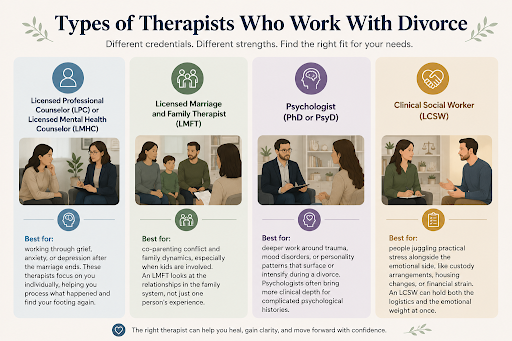
Types of divorce therapists for emotional healing

Here’s a quick breakdown of the different credential types and who they tend to be the right fit for.

Licensed Professional Counselor (LPC) or Licensed Mental Health Counselor (LMHC)

Best for: working through grief, anxiety, or depression after the marriage ends. These therapists focus on you individually, helping you process what happened and find your footing again 

Licensed Marriage and Family Therapist (LMFT)

Best for: co-parenting conflict and family dynamics, especially when kids are involved. An LMFT looks at the relationships in the family system, not just one person’s experience.

Psychologist (PhD or PsyD)

Best for: deeper work around trauma, mood disorders, or personality patterns that surface or intensify during a divorce. Psychologists often bring more clinical depth for complicated psychological histories.

Clinical Social Worker (LCSW)

Best for: people juggling practical stress alongside the emotional side, like custody arrangements, housing changes, or financial strain. An LCSW can hold both the logistics and the emotional weight at once.

Read More Blog : Therapy for Mental Health Issues

What Type of Therapy Works Best for Divorce?

Who you see matters, but how the therapy is structured matters too. A few approaches show up often in divorce recovery.

Cognitive behavioral therapy (CBT) helps with the anxious, looping thoughts that tend to show up after a divorce, things like replaying old arguments or catastrophizing about the future. 

Narrative therapy focuses on rebuilding your sense of identity, which is especially useful for women who built a lot of their self-image around their marriage or role as a spouse. 

Solution-focused therapy is more short-term and practical, good for people who already know they’re struggling but want clear next steps instead of open-ended processing. 

Mindfulness-based approaches help with the day-to-day grief and stress that can otherwise feel constant in the months after a divorce.

The specific approach matters less than finding a therapist who tailors treatment to your situation and goals. 

None of these are exclusive. Therapists often blend a few of these approaches depending on where you are in the process.

How Divorce Therapy Helps Women Rebuild Self-Confidence

Woman rebuilding confidence through divorce therapy

Divorce hits differently depending on what you built your identity around. Women who were financially dependent, in long marriages, or who centered a lot of their daily life around being a spouse often face a specific kind of confidence crisis after divorce, separate from grief alone.

It’s not just sadness. It’s not knowing who you are without the role you’ve played for years, and sometimes not trusting your own judgment after a relationship that didn’t work out the way you expected.

Therapy helps here in a few specific ways. Narrative work helps separate who you are from the marriage that ended. 

Self-compassion exercises help quiet the self-blame that tends to creep in, even when the divorce wasn’t really about anything you did wrong. 

And over time, sessions shift toward practical goal-setting, helping restore a sense of direction and independence that may have gotten lost. 

Read More Blog : What Is Family Therapy

When to See a Family Divorce Therapist

Sometimes the divorce isn’t just a two-person issue. A few signs it’s time to bring family into the picture:

Your child is showing signs of distress, withdrawal, or behavior changes that started around the separation. Communication with your co-parent keeps breaking down, even over basic logistics. The whole household feels unstable, not just the adults.

In any of these cases, a family therapist works with the relationships involved instead of just one person’s experience of the divorce.

The Biggest Mistake People Make When Choosing a Divorce Therapist

The most common mistake is matching the wrong type of therapist to the actual problem. Seeing a couples therapist when you need individual support, or going the individual route when the real conflict is happening between co-parents.

The second mistake is skipping the vetting step. Not every therapist works with divorce specifically. And general talk therapy doesn’t always cover the legal, financial, and identity pieces that come with it. 

It’s worth asking directly if divorce or life transitions is something a therapist actually specializes in before booking.

What to Expect in Post-Divorce Therapy

Early sessions usually focus on the immediate aftermath, working through grief, anger, or the shock of the situation, even when the divorce was expected or mutual.

As sessions continue, the focus tends to shift toward identity and coping. This is where narrative work, communication skills, and co-parenting strategies usually come in, depending on the situation.

Later sessions look forward instead of back. This phase is about regaining confidence, figuring out what you want next, and starting to think about life beyond the divorce instead of just recovering from it.

How to Find the Right Divorce Therapist for You

A few things worth checking before booking a first session.

Look for someone who lists divorce or life transitions as an area they specialize in, not just general therapy. Make sure their credentials match your actual need: an LMFT for family or co-parenting work, an LPC or LMHC for individual support. 

Schedule an initial consultation first; fit matters more than credentials alone. And ask directly how they approach divorce recovery, since two therapists with the same license can work very differently.

Finding the Right Support Changes What Comes Next 

Divorce changes a lot at once: your routine, your identity, sometimes your entire support system. The right therapist doesn’t just help you get through it. If you’re unsure which type of therapist is right for your situation, Integrated Counseling Services can help you find the right fit. 

Their licensed therapists work with individuals, co-parents, and families navigating divorce through practical, personalized support. Schedule a consultation to discuss what comes next. 
Read More
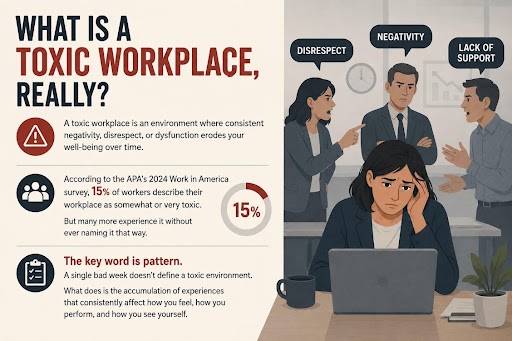
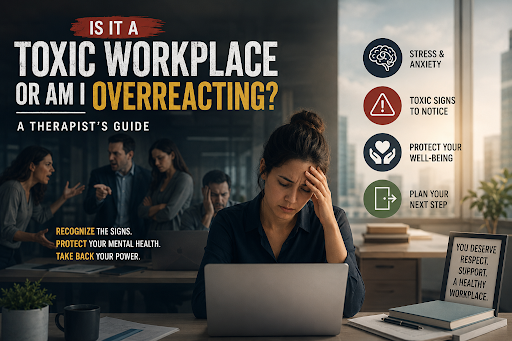
Illustration of a toxic workplace affecting employee well-being.

Is It a Toxic Workplace or Am I Overreacting?

If you’ve been asking yourself this question, you’re not alone — and the fact that you’re asking it matters. Most people don’t start by questioning their workplace. They start by questioning themselves. This guide helps you understand what a toxic workplace actually looks like, why it’s so hard to recognize, and what you can do about it.

What Is a Toxic Workplace, Really?

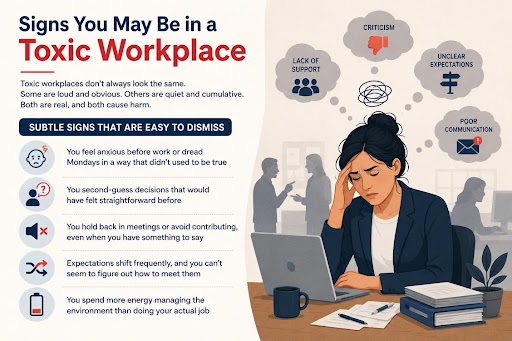
Signs You May Be in a Toxic Workplace

Toxic workplaces don’t always look the same. Some are loud and obvious. Others are quiet and cumulative. Both are real, and both cause harm.

Subtle Signs That Are Easy to Dismiss

  • You feel anxious before work or dread Mondays in a way that didn’t used to be true
  • You second-guess decisions that would have felt straightforward before
  • You hold back in meetings or avoid contributing, even when you have something to say
  • Expectations shift frequently, and you can’t seem to figure out how to meet them
  • You spend more energy managing the environment than doing your actual job

A toxic workplace is an environment where consistent negativity, disrespect, or dysfunction erodes your well-being over time. It’s not just a stressful job or a demanding boss. It’s a pattern — one that leaves you feeling unsafe, uncertain, or diminished on a regular basis.

According to the APA’s 2024 Work in America survey, 15% of workers describe their workplace as somewhat or very toxic. But many more experience it without ever naming it that way.

The key word is pattern. A single bad week doesn’t define a toxic environment. What does is the accumulation of experiences that consistently affect how you feel, how you perform, and how you see yourself.

Why You Question Yourself First

Most people don’t start by questioning the workplace. They start by questioning themselves. They notice they feel more anxious before meetings than they used to. They replay small interactions long after the workday ends. They hesitate before speaking up, even in situations where they would normally feel comfortable.

And then almost immediately, they try to explain it away. “Maybe I’m overthinking this. Maybe I’ve just become more sensitive.”

The Habit of Explaining It Away

That instinct is understandable. Most people have been taught to push through discomfort rather than analyze it. Work is not supposed to feel easy all the time, and there’s often pressure — internal and external — to keep going without complaint.

The problem is that this habit makes it harder to recognize when the discomfort isn’t just part of the job. In many cases, what feels like personal sensitivity is actually a reaction to a workplace issue that hasn’t been clearly identified yet.

You are not overreacting. You are responding. And that response is worth paying attention to.

Also Read: Is It Love or Obligation?

Healthy Work Pressure vs. a Toxic Environment: What’s the Difference?

A demanding job can take a lot out of you. But it usually makes sense. You understand why you feel tired. There are deadlines, expectations, and responsibilities that require real effort — and even when it’s difficult, there’s a certain clarity to it.

What tends to feel different in a harmful environment isn’t just the level of pressure. It’s the type of impact it has on you.

Here’s a practical way to tell them apart:

  • Healthy pressure challenges your capacity. You feel stretched, but you understand what’s expected. Feedback is consistent enough to learn from.
  • A toxic environment affects your stability and self-trust. Expectations shift without warning. Feedback feels contradictory. You spend more time interpreting people than actually doing your work.

The clearest signal? In a healthy setting, effort leads to some form of clarity or recognition. In a toxic one, no matter how hard you work or how carefully you communicate, things don’t improve — and often get worse.

Signs You May Be in a Toxic Workplace

Employee showing stress and anxiety in a toxic workplace with common warning signs illustrated around them.

Toxic workplaces don’t always look the same. Some are loud and obvious. Others are quiet and cumulative. Both are real, and both cause harm.

Subtle Signs That Are Easy to Dismiss

  • You feel anxious before work or dread Mondays in a way that didn’t used to be true
  • You second-guess decisions that would have felt straightforward before
  • You hold back in meetings or avoid contributing, even when you have something to say
  • Expectations shift frequently, and you can’t seem to figure out how to meet them
  • You spend more energy managing the environment than doing your actual job

More Serious Patterns to Take Seriously

  • Fear-based leadership: Constant micromanagement, threats, or using fear as a management tool
  • Gaslighting: Being told your perception of events is wrong, or that you’re “too sensitive”
  • Exclusion: Being left out of conversations that directly affect your role
  • Credit theft and blame-shifting: Your work gets claimed by others; your mistakes get amplified
  • Retaliation risk: You’re afraid to speak up, set a boundary, or report a problem because of what might happen
  • High turnover: People keep leaving, and no one talks openly about why

None of these moments have to be dramatic to be serious. Workplace harassment frequently develops through repeated small patterns, not single extreme incidents. The impact comes from repetition — and over time, even subtle patterns change how comfortable and confident you feel participating at all.

If you’re struggling with stress and anxiety management, working through what you’re experiencing in a safe therapeutic space can help you separate the environmental from the internal — and respond from a clearer place.

How a Toxic Workplace Affects You Over Time

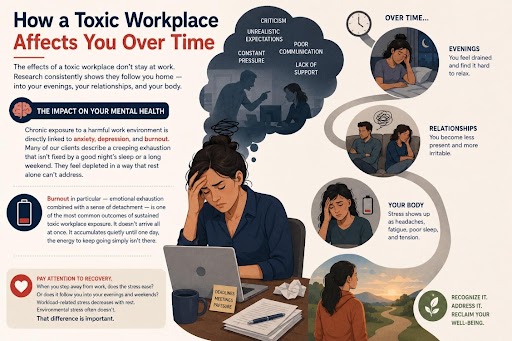
Stressed employee illustrating the long-term mental and emotional effects of a toxic workplace.

The effects of a toxic workplace don’t stay at work. Research consistently shows they follow you home — into your evenings, your relationships, and your body.

The Impact on Your Mental Health

Chronic exposure to a harmful work environment is directly linked to anxiety, depression, and burnout. Many of our clients describe a creeping exhaustion that isn’t fixed by a good night’s sleep or a long weekend. They feel depleted in a way that rest alone can’t address.

Burnout in particular — emotional exhaustion combined with a sense of detachment — is one of the most common outcomes of sustained toxic workplace exposure. It doesn’t arrive all at once. It accumulates quietly until one day, the energy to keep going simply isn’t there.

Pay attention to recovery. When you step away from work, does the stress ease? Or does it follow you into your evenings and weekends? Workload-related stress decreases with rest. Environmental stress often doesn’t. That difference is important.

The Impact on Your Sense of Self

This is the part that doesn’t always get talked about. Beyond anxiety and burnout, prolonged exposure to a toxic environment can quietly erode your confidence, your sense of competence, and your trust in your own judgment.

You may start doubting abilities that were never in question before. You may feel the need to constantly prove your value — to colleagues, to leadership, or even to yourself. Over time, the experience stops being about the work and becomes about managing the environment just to survive each day.

In our experience, this erosion of self-trust is often one of the hardest things to recover from — and one of the most important reasons to take your experience seriously before it compounds further.

Also Read: What Is Family Therapy?

What You Can Do Right Now

While You’re Still in the Job

  • Document everything. Keep a private log of specific incidents, dates, and any witnesses. This is essential if you ever need to escalate to HR or make an unemployment claim.
  • Set real boundaries. Stop answering emails outside of work hours. Don’t take on more than is humanly possible for your role. Protect your time off.
  • Build a support network outside the toxic circle. Connect with peers, friends, or a therapist who can offer perspective that isn’t colored by the environment you’re in.
  • Know your rights. If the toxicity involves illegal discrimination, harassment, or retaliation, you have legal options. Your state’s labor board and the federal EEOC are starting points.

If You’re Ready to Plan Your Exit

  • Update your resume and LinkedIn now — not after you leave
  • Reach out to trusted contacts before you need to
  • If you’re in a couple or family situation, couple therapy can help you and your partner navigate the stress of a career transition together
  • Your long-term mental and physical health is the priority. No job is worth sacrificing both.

When It’s Time to Talk to Someone

You don’t need to hit a breaking point to seek support. If your work environment is consistently leaving you feeling uncertain, diminished, or unable to show up as yourself, that is reason enough.

Therapy offers something that friends, family, and HR cannot: a structured space to untangle what’s happening, separate your reactions from the environment’s influence, and rebuild the self-trust that a toxic workplace can quietly take from you.

Many people come to us after months of trying to fix the situation themselves — adjusting how they communicate, working harder, being more careful. What they often discover in therapy is that the problem was never theirs to fix. Processing that realization, and moving forward from it, is exactly what this work is for.

If you’re ready to talk, our stress and anxiety management services are available in Rhode Island and online, and our approach is always tailored to your specific experience — not a one-size-fits-all framework.

Frequently Asked Questions

How do I know if my workplace is toxic or if I’m just stressed?

The key difference is pattern and recovery. Normal work stress tends to ease when the pressure lifts — after a deadline, over a weekend. A toxic environment follows you home and doesn’t improve even when you rest or adjust your approach. If your stress feels tied to the environment itself rather than a specific workload, that’s a meaningful signal.

Can a toxic workplace cause anxiety and depression?

Yes. Research clearly links sustained exposure to harmful work environments with anxiety, depression, burnout, and even physical health problems. Many people experience these symptoms without connecting them to their job. If you’ve noticed a significant change in your mood, energy, or self-confidence that aligns with your work situation, it’s worth taking seriously.

What should I do if I can’t afford to leave my toxic job right now?

Focus on what you can control. Set firm boundaries around your time and energy. Document incidents carefully. Build a support network outside of work. Prioritize your mental health through therapy or other self-care practices. And start quietly preparing your exit — updating your resume, connecting with your network — so that leaving becomes an option rather than an emergency.

Is workplace harassment always obvious?

No. Harassment often develops through patterns of small, individually dismissible incidents — being regularly interrupted, excluded, undermined through “jokes,” or blamed unfairly. None of these seem extreme in isolation. But the cumulative impact on your confidence and comfort is real and serious. You don’t need a single dramatic incident to take what you’re experiencing seriously.

When should I consider therapy for workplace stress?

Consider therapy when work stress is affecting your sleep, your relationships, your confidence, or your sense of self — not just your performance. You don’t need to be in crisis to benefit. A therapist can help you understand what’s happening, process the experience, and build strategies for protecting your well-being whether you stay or leave.

Can toxic workplace stress affect my relationships at home?

Absolutely. Workplace trauma doesn’t stay at work. Many people find that the exhaustion, irritability, and emotional withdrawal caused by a toxic environment spills into their home life and closest relationships. Addressing the root cause — and the emotional impact — is important for your relationships as much as your career.

Support Is Available in Rhode Island and Online

If what you’ve read here resonates with you, you don’t have to navigate it alone. At Integrated Counseling Service, we work with individuals who are processing the stress, confusion, and self-doubt that a difficult work environment can create.

With more than 15 years of experience and 25,000+ sessions, our approach is warm, practical, and grounded in your specific situation — not a generic framework. We serve clients in Pawtucket, Rhode Island, and offer online therapy across Massachusetts, Texas, and beyond.

Reaching out is not a sign that you’ve failed. It’s a sign that you’re ready to stop absorbing what was never yours to carry.

Book a session for Toxic Workplace today.

Book a session for Toxic Workplace today.

Read More

Service Areas

We proudly serve multiple locations across Massachusetts and Texas.

📍 Quincy, Massachusetts
📍 Waltham, Massachusetts
📍 Newton Upper Falls, Massachusetts
📍 Lexington, Massachusetts
📍 Malden, Massachusetts
📍 Cambridge (Kendall Square), Massachusetts
📍 Hopkinton, Massachusetts
📍 Plano, Texas
📍 Frisco, Texas
📍 McKinney, Texas
📍 Garland, Texas
📍 Dallas (Oak Lawn), Texas
📍 Rockwall, Texas
📍 Little Elm, Texas
📍 Irving, Texas
📍 Houston, Texas
📍 Sugar Land, Texas
📍 Richmond, Texas
📍 Dallas, Texas