
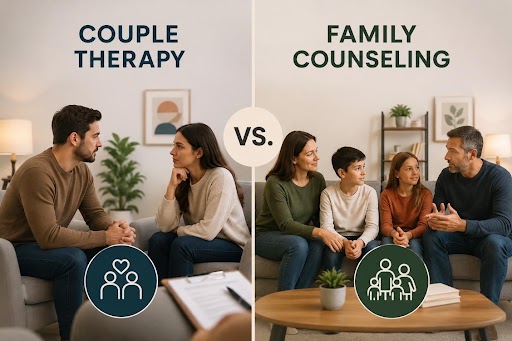
If you’re trying to figure out whether you need couple therapy or family counseling, you’re not alone — and the confusion is understandable. They sound similar. They’re both relational. But they serve different people, address different problems, and work in meaningfully different ways. This guide explains the difference clearly so you can find the right starting point.
What Is Couple Therapy?
Couple therapy is a form of psychotherapy focused specifically on the two-person romantic relationship. The unit of care is the partnership itself not either individual in isolation, and not the broader family system.
It’s designed for partners who are struggling with what’s happening between them: the patterns that repeat, the distance that’s grown, the trust that’s been damaged, or the connection that’s quietly gone missing.
What Couple Therapy Actually Addresses
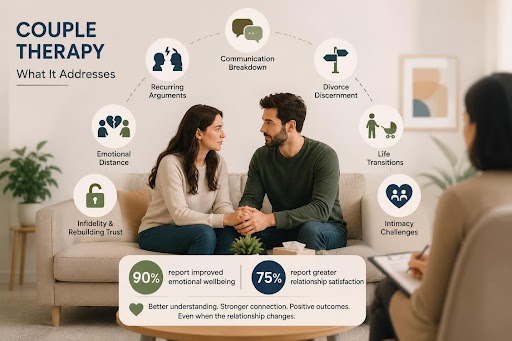
- Recurring arguments that circle the same ground without resolution
- Emotional distance or disconnection between partners
- Infidelity and rebuilding trust after a breach
- Communication breakdown — where conversations either escalate or shut down
- Divorce discernment — when one or both partners aren’t sure whether to stay
- Life transitions that have shifted the dynamic: new parenthood, career changes, relocation
- Intimacy challenges — emotional, physical, or both
Research shows that nearly 90% of people who complete couples counseling report improvement in their emotional wellbeing, and over 75% report greater relationship satisfaction. And here’s what surprises most people: couple therapy produces positive outcomes even in cases where the relationship ultimately ends — because the goal was never just to keep two people together. It was to help them understand each other, and themselves, more clearly.
Techniques Used in Couple Therapy
- The Gottman Method focuses on conflict resolution, friendship, and shared meaning — particularly effective when arguments feel circular or trust has been damaged
- Emotion-Focused Therapy (EFT) helps partners understand the attachment patterns beneath their conflicts — the fear, withdrawal, and pursuit cycles that keep repeating even when both people want things to be different
- Behavioral Couples Therapy (BCT) works on reinforcing positive patterns and reducing the negative behaviors that create distance and resentment over time
Also Read: Is It Love or Obligation?
What Is Family Counseling?
What Is Family Therapy? Family counseling is a form of therapy that brings in the broader household—parents, children, and sometimes extended family members—to address how the family system as a whole is functioning. The central premise is that no one person’s behavior happens in isolation. The way a family communicates, what’s allowed to be said, what gets buried, and who carries what all create a system. When that system is under enough stress, it shows up in everyone. Sometimes it shows up most visibly in the person least equipped to hide it.
What Family Counseling Actually Addresses
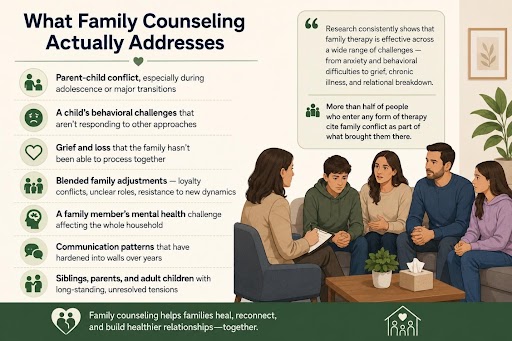
- Parent-child conflict, especially during adolescence or major transitions
- A child’s behavioral challenges that aren’t responding to other approaches
- Grief and loss that the family hasn’t been able to process together
- Blended family adjustments — loyalty conflicts, unclear roles, resistance to new dynamics
- A family member’s mental health challenge affecting the whole household
- Communication patterns that have hardened into walls over years
- Siblings, parents, and adult children with long-standing, unresolved tensions
Research consistently shows that family therapy is effective across a wide range of challenges — from anxiety and behavioral difficulties to grief, chronic illness, and relational breakdown. More than half of people who enter any form of therapy cite family conflict as part of what brought them there.
Techniques Used in Family Counseling
- Structural Family Therapy examines the boundaries, roles, and power dynamics within the family unit — and works to reshape them into something healthier
- Systemic Family Therapy looks at how the family functions within broader contexts: cultural background, social pressures, community ties, and generational patterns
- Functional Family Therapy (FFT) is particularly useful when children are struggling with behavioral issues — it assesses family dynamics and builds communication and parenting skills
Also Read: What Is Family Therapy, And How Can It Help Your Family?
The Core Difference Between Couple Therapy and Family Counseling
The clearest way to understand the difference is this: it comes down to who the therapy is designed to serve, and where the pain is primarily located.
Couple therapy focuses on the two-person romantic dynamic. The therapist works with the partnership — the communication between partners, the trust or lack of it, the emotional distance, and the patterns that repeat regardless of how much both people want things to change.
Family counseling focuses on the household system. It’s not about one person’s problem or one couple’s conflict. It’s about the patterns everyone is living inside — how roles get assigned, how communication flows or breaks down, and how stress in one part of the family ripples through all of it.
Here’s a direct comparison:
- Unit of care: Couple therapy = two partners. Family counseling = the household as a system.
- Primary focus: Couple therapy = romantic relationship, intimacy, communication, trust. Family counseling = family roles, boundaries, multi-member dynamics.
- Common issues: Couple therapy = infidelity, recurring conflict, emotional detachment, divorce discernment. Family counseling = parent-child conflict, grief, blended family challenges, behavioral issues.
- Techniques: Couple therapy = Gottman Method, EFT, BCT. Family counseling = Structural, Systemic, and Functional Family Therapy.
When Couple Therapy and Family Counseling Overlap
These two approaches are distinct — but they often intersect in real life. And that’s worth knowing before you choose.
A couple may begin couple therapy to work through a marital issue. If that issue is affecting the children, creating tension throughout the household, or leading toward divorce, the focus naturally expands to include the whole family. A therapist skilled in both can help you navigate that transition without starting over from scratch.
Similarly, a family may enter family counseling with what looks like a child’s behavioral problem — only to discover that the root of it is unresolved tension between the parents. In that case, a period of couple therapy alongside or after family work may be what actually produces change.
In our experience working with families across cultures and life situations, the cleanest outcomes usually come from starting with the most pressing pain point, and letting the work reveal what else needs attention.
Does Couple Therapy Online Work as Well as In-Person?
Yes. A 2024 study following 490 participants found no meaningful difference in outcomes between online and in-person couples therapy. Some couples find it easier, actually — being in their own space lowers the guard just enough to have the conversations that matter.
How to Choose: Which One Is Right for You?
You don’t need to have this figured out before you reach out. Helping you understand what kind of support fits your situation is part of what a therapist does. But if you’re trying to make sense of it tonight:
- If the pain is between you and your partner — the communication, the trust, the recurring arguments, the emotional distance — couple therapy is where the work is
- If the pain has spread across the whole household — if it’s in the air at home, if everyone is feeling it even if nobody’s talking about it — family counseling is built for that
- If you’re not sure whether it’s a couple issue or a family issue — say that. A good therapist won’t make you feel foolish for not knowing. They’ll help you find out.
And if something feels internal — more about you than about anyone else — that’s when individual therapy is the right starting point, before or alongside relational work.
Frequently Asked Questions
What is the main difference between couple therapy and family counseling?
Couple therapy focuses on the romantic relationship between two partners — communication, trust, intimacy, and recurring conflict. Family counseling addresses the broader household dynamic, bringing in children or other family members to work on patterns that affect everyone. The key distinction is the unit of care: couple therapy centers the partnership; family counseling centers the family system.
Can we do couple therapy and family counseling at the same time?
Yes, and in many cases it makes sense to. A couple working through marital issues may also benefit from family sessions if those issues are affecting the children. A therapist experienced in both can help coordinate the work so nothing gets duplicated and both sets of needs are addressed.
What techniques do couple therapists use?
The most widely used approaches are the Gottman Method — which focuses on conflict resolution, friendship, and shared meaning — and Emotion-Focused Therapy (EFT), which helps partners understand and shift the attachment patterns beneath their conflicts. Behavioral Couples Therapy (BCT) is also commonly used to reinforce positive patterns and reduce behaviors that create distance over time.
What techniques do family counselors use?
Family therapists commonly draw on Structural Family Therapy, which examines and reshapes boundaries and roles within the household, and Systemic Family Therapy, which considers how broader cultural and social contexts shape the way a family functions. Functional Family Therapy (FFT) is particularly useful when children are dealing with behavioral challenges.
Is online couple therapy as effective as in-person?
Yes. Research, including a 2024 study of 490 participants, found no meaningful difference in outcomes between online and in-person couples therapy. Many couples find the online format easier to commit to consistently — and consistency is one of the strongest predictors of good outcomes in therapy.
How do I know if my family needs family counseling or if one person needs individual therapy?
If the challenges seem to belong to one specific person — their mental health, their history, their internal experience — individual therapy is usually the right starting point. If the challenges are relational — how family members interact, communicate, or affect each other — family counseling addresses the root more directly. Often, both are helpful at different points, and one tends to inform the other.
Therapy in Rhode Island and Online — We’re Here When You’re Ready
Whether what you’re facing lives between you and your partner, or in the wider space of your family, the right support makes a real difference. At Integrated Counseling Service, we work with couples and families across a wide range of situations — and we meet you where you are, not where you think you’re supposed to be.
Dr. Noreen Shaffi has worked with individuals, couples, and families for more than 15 years — more than 25,000 sessions across cultures, countries, and life situations. Her approach is warm, direct, and grounded in your specific reality.
Couple therapy, family counseling, and individual therapy are available in Pawtucket, Rhode Island, and online across Massachusetts, Texas, and beyond. You don’t need to have the right words when you reach out. You just have to reach out.