
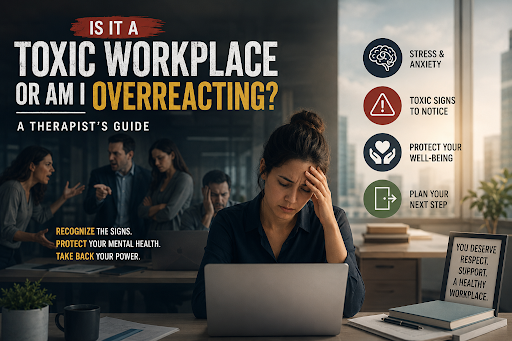
If you’ve been asking yourself this question, you’re not alone — and the fact that you’re asking it matters. Most people don’t start by questioning their workplace. They start by questioning themselves. This guide helps you understand what a toxic workplace actually looks like, why it’s so hard to recognize, and what you can do about it.
What Is a Toxic Workplace, Really?
Toxic workplaces don’t always look the same. Some are loud and obvious. Others are quiet and cumulative. Both are real, and both cause harm.
Subtle Signs That Are Easy to Dismiss
- You feel anxious before work or dread Mondays in a way that didn’t used to be true
- You second-guess decisions that would have felt straightforward before
- You hold back in meetings or avoid contributing, even when you have something to say
- Expectations shift frequently, and you can’t seem to figure out how to meet them
- You spend more energy managing the environment than doing your actual job
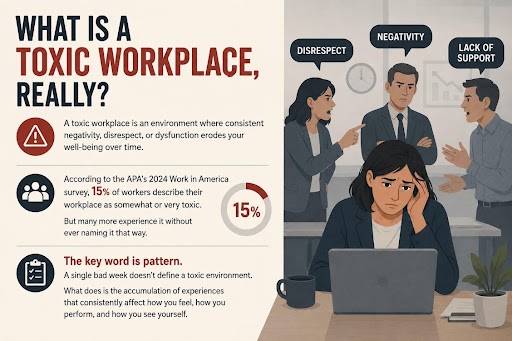
A toxic workplace is an environment where consistent negativity, disrespect, or dysfunction erodes your well-being over time. It’s not just a stressful job or a demanding boss. It’s a pattern — one that leaves you feeling unsafe, uncertain, or diminished on a regular basis.
According to the APA’s 2024 Work in America survey, 15% of workers describe their workplace as somewhat or very toxic. But many more experience it without ever naming it that way.
The key word is pattern. A single bad week doesn’t define a toxic environment. What does is the accumulation of experiences that consistently affect how you feel, how you perform, and how you see yourself.
Why You Question Yourself First
Most people don’t start by questioning the workplace. They start by questioning themselves. They notice they feel more anxious before meetings than they used to. They replay small interactions long after the workday ends. They hesitate before speaking up, even in situations where they would normally feel comfortable.
And then almost immediately, they try to explain it away. “Maybe I’m overthinking this. Maybe I’ve just become more sensitive.”
The Habit of Explaining It Away
That instinct is understandable. Most people have been taught to push through discomfort rather than analyze it. Work is not supposed to feel easy all the time, and there’s often pressure — internal and external — to keep going without complaint.
The problem is that this habit makes it harder to recognize when the discomfort isn’t just part of the job. In many cases, what feels like personal sensitivity is actually a reaction to a workplace issue that hasn’t been clearly identified yet.
You are not overreacting. You are responding. And that response is worth paying attention to.
Also Read: Is It Love or Obligation?
Healthy Work Pressure vs. a Toxic Environment: What’s the Difference?
A demanding job can take a lot out of you. But it usually makes sense. You understand why you feel tired. There are deadlines, expectations, and responsibilities that require real effort — and even when it’s difficult, there’s a certain clarity to it.
What tends to feel different in a harmful environment isn’t just the level of pressure. It’s the type of impact it has on you.
Here’s a practical way to tell them apart:
- Healthy pressure challenges your capacity. You feel stretched, but you understand what’s expected. Feedback is consistent enough to learn from.
- A toxic environment affects your stability and self-trust. Expectations shift without warning. Feedback feels contradictory. You spend more time interpreting people than actually doing your work.
The clearest signal? In a healthy setting, effort leads to some form of clarity or recognition. In a toxic one, no matter how hard you work or how carefully you communicate, things don’t improve — and often get worse.
Signs You May Be in a Toxic Workplace
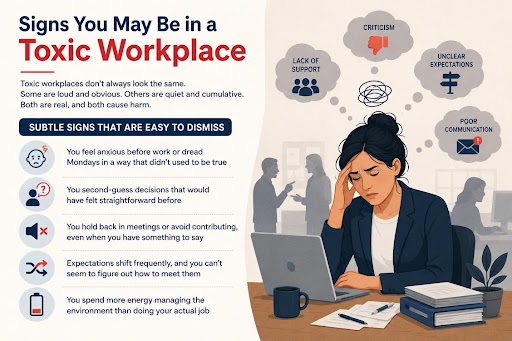
Toxic workplaces don’t always look the same. Some are loud and obvious. Others are quiet and cumulative. Both are real, and both cause harm.
Subtle Signs That Are Easy to Dismiss
- You feel anxious before work or dread Mondays in a way that didn’t used to be true
- You second-guess decisions that would have felt straightforward before
- You hold back in meetings or avoid contributing, even when you have something to say
- Expectations shift frequently, and you can’t seem to figure out how to meet them
- You spend more energy managing the environment than doing your actual job
More Serious Patterns to Take Seriously
- Fear-based leadership: Constant micromanagement, threats, or using fear as a management tool
- Gaslighting: Being told your perception of events is wrong, or that you’re “too sensitive”
- Exclusion: Being left out of conversations that directly affect your role
- Credit theft and blame-shifting: Your work gets claimed by others; your mistakes get amplified
- Retaliation risk: You’re afraid to speak up, set a boundary, or report a problem because of what might happen
- High turnover: People keep leaving, and no one talks openly about why
None of these moments have to be dramatic to be serious. Workplace harassment frequently develops through repeated small patterns, not single extreme incidents. The impact comes from repetition — and over time, even subtle patterns change how comfortable and confident you feel participating at all.
If you’re struggling with stress and anxiety management, working through what you’re experiencing in a safe therapeutic space can help you separate the environmental from the internal — and respond from a clearer place.
How a Toxic Workplace Affects You Over Time
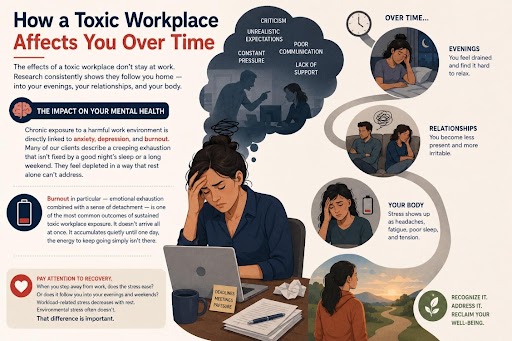
The effects of a toxic workplace don’t stay at work. Research consistently shows they follow you home — into your evenings, your relationships, and your body.
The Impact on Your Mental Health
Chronic exposure to a harmful work environment is directly linked to anxiety, depression, and burnout. Many of our clients describe a creeping exhaustion that isn’t fixed by a good night’s sleep or a long weekend. They feel depleted in a way that rest alone can’t address.
Burnout in particular — emotional exhaustion combined with a sense of detachment — is one of the most common outcomes of sustained toxic workplace exposure. It doesn’t arrive all at once. It accumulates quietly until one day, the energy to keep going simply isn’t there.
Pay attention to recovery. When you step away from work, does the stress ease? Or does it follow you into your evenings and weekends? Workload-related stress decreases with rest. Environmental stress often doesn’t. That difference is important.
The Impact on Your Sense of Self
This is the part that doesn’t always get talked about. Beyond anxiety and burnout, prolonged exposure to a toxic environment can quietly erode your confidence, your sense of competence, and your trust in your own judgment.
You may start doubting abilities that were never in question before. You may feel the need to constantly prove your value — to colleagues, to leadership, or even to yourself. Over time, the experience stops being about the work and becomes about managing the environment just to survive each day.
In our experience, this erosion of self-trust is often one of the hardest things to recover from — and one of the most important reasons to take your experience seriously before it compounds further.
Also Read: What Is Family Therapy?
What You Can Do Right Now
While You’re Still in the Job
- Document everything. Keep a private log of specific incidents, dates, and any witnesses. This is essential if you ever need to escalate to HR or make an unemployment claim.
- Set real boundaries. Stop answering emails outside of work hours. Don’t take on more than is humanly possible for your role. Protect your time off.
- Build a support network outside the toxic circle. Connect with peers, friends, or a therapist who can offer perspective that isn’t colored by the environment you’re in.
- Know your rights. If the toxicity involves illegal discrimination, harassment, or retaliation, you have legal options. Your state’s labor board and the federal EEOC are starting points.
If You’re Ready to Plan Your Exit
- Update your resume and LinkedIn now — not after you leave
- Reach out to trusted contacts before you need to
- If you’re in a couple or family situation, couple therapy can help you and your partner navigate the stress of a career transition together
- Your long-term mental and physical health is the priority. No job is worth sacrificing both.
When It’s Time to Talk to Someone
You don’t need to hit a breaking point to seek support. If your work environment is consistently leaving you feeling uncertain, diminished, or unable to show up as yourself, that is reason enough.
Therapy offers something that friends, family, and HR cannot: a structured space to untangle what’s happening, separate your reactions from the environment’s influence, and rebuild the self-trust that a toxic workplace can quietly take from you.
Many people come to us after months of trying to fix the situation themselves — adjusting how they communicate, working harder, being more careful. What they often discover in therapy is that the problem was never theirs to fix. Processing that realization, and moving forward from it, is exactly what this work is for.
If you’re ready to talk, our stress and anxiety management services are available in Rhode Island and online, and our approach is always tailored to your specific experience — not a one-size-fits-all framework.
Frequently Asked Questions
How do I know if my workplace is toxic or if I’m just stressed?
The key difference is pattern and recovery. Normal work stress tends to ease when the pressure lifts — after a deadline, over a weekend. A toxic environment follows you home and doesn’t improve even when you rest or adjust your approach. If your stress feels tied to the environment itself rather than a specific workload, that’s a meaningful signal.
Can a toxic workplace cause anxiety and depression?
Yes. Research clearly links sustained exposure to harmful work environments with anxiety, depression, burnout, and even physical health problems. Many people experience these symptoms without connecting them to their job. If you’ve noticed a significant change in your mood, energy, or self-confidence that aligns with your work situation, it’s worth taking seriously.
What should I do if I can’t afford to leave my toxic job right now?
Focus on what you can control. Set firm boundaries around your time and energy. Document incidents carefully. Build a support network outside of work. Prioritize your mental health through therapy or other self-care practices. And start quietly preparing your exit — updating your resume, connecting with your network — so that leaving becomes an option rather than an emergency.
Is workplace harassment always obvious?
No. Harassment often develops through patterns of small, individually dismissible incidents — being regularly interrupted, excluded, undermined through “jokes,” or blamed unfairly. None of these seem extreme in isolation. But the cumulative impact on your confidence and comfort is real and serious. You don’t need a single dramatic incident to take what you’re experiencing seriously.
When should I consider therapy for workplace stress?
Consider therapy when work stress is affecting your sleep, your relationships, your confidence, or your sense of self — not just your performance. You don’t need to be in crisis to benefit. A therapist can help you understand what’s happening, process the experience, and build strategies for protecting your well-being whether you stay or leave.
Can toxic workplace stress affect my relationships at home?
Absolutely. Workplace trauma doesn’t stay at work. Many people find that the exhaustion, irritability, and emotional withdrawal caused by a toxic environment spills into their home life and closest relationships. Addressing the root cause — and the emotional impact — is important for your relationships as much as your career.
Support Is Available in Rhode Island and Online
If what you’ve read here resonates with you, you don’t have to navigate it alone. At Integrated Counseling Service, we work with individuals who are processing the stress, confusion, and self-doubt that a difficult work environment can create.
With more than 15 years of experience and 25,000+ sessions, our approach is warm, practical, and grounded in your specific situation — not a generic framework. We serve clients in Pawtucket, Rhode Island, and offer online therapy across Massachusetts, Texas, and beyond.
Reaching out is not a sign that you’ve failed. It’s a sign that you’re ready to stop absorbing what was never yours to carry.