

Family therapy which is also known as family counselling, is a type of psychotherapy designed to improve communication, resolve conflicts, and strengthen relationships among family members by viewing problems within the context of the entire unit. Its core purpose lies in treating mental health issues, reducing family tension, and developing a supportive environment.
This guide will cover what family counselling is, family counselling services, key benefits, and ultimately how it can help your family according to their respective needs.
What is family counselling?

Family counselling aims to address psychological, behavioural, and emotional issues that cause family problems. Family members will work with a therapist or counsellor to develop and maintain a healthy relationship.
Family system theory is a scientific theory of human behaviour that views the family as an interconnected and interdependent system. Each member’s behaviour and interactions are seen as influencing the entire family unit. It emphasises the importance of relationships and interactions among family members. It asserts that issues within a family cannot be understood in isolation but rather as part of the larger system.
People often use family counselling and therapy interchangeably, but there are subtle differences in both:
Counselling tends to be more focused on one specific issue and is considered as a short-term treatment. You may learn coping techniques and “problem-solve” issues together. On the other hand, therapy tends to treat a broader range of issues and more complex problems. It can be a long-term treatment.
What is the primary goal of family therapy?
The main goal of family therapy is to improve the family’s ability to function, establish healthy boundaries, and teach the family how to solve future problems without the therapist’s help.
Types of Mental Health Services: A Complete Guide
The Core Benefits Of Family Counselling
Family counselling helps families to improve their communication, resolve conflicts, and build stronger relationships.
Although it also has a wider coverage in terms of its worth, some of them are listed below:
- Improve communication: Any type of therapy includes communication, so family therapy guides you to be more open and provides a platform where you can feel more comfortable and discuss your feelings in a neutral environment free from judgement.
- Resolving conflict: Family counselling is a good tool to explore conflict among family members and potentially resolve them, as in any stance, where one family member does not get along with other conflicts will arise.
- Coping skills: Family therapy also emphasises coping skills, as it includes techniques like problem-solving and psychoeducation about stress, which help families to develop resilience.
- Setting boundaries: If in your family, you feel uncomfortable because everyone is entitled to your time and attention, and you can’t even say no for the other person’s sake. Family counselling will help you set clear, healthy boundaries based on your feelings, needs and wants.
- Strengthen relationships: The general cause of families going to therapy is that their bond is not strong enough, or that they feel emotionally distant from each other. Family counselling helps those families to revitalise their bond so that they can feel close to each other.
- Addressing any grief or loss: Family counselling helps families suffering from any psychological shock or loss, as many changes like divorce, death, unemployment, or bankruptcy can trigger problems in families.
How does family counselling help with communication?

Communication is the primary reason families seek therapy. Family therapy creates a place where people can talk about things without being afraid. A therapist helps the family talk to each other in ways. This means family members can understand each other and get along better. Family therapy makes family relationships stronger.
Imagine a teenager who starts spending most of their time alone in their room. The parents may see this as rude or distant behaviour, which often leads to arguments and more emotional distance. In family counselling, each person is encouraged to express what they truly feel instead of reacting to the behaviour alone.
A parent might share feeling worried or disconnected, while the teen may explain feeling stressed and emotionally drained. Once both sides understand the emotions behind the actions, the family can work on small compromises that create both personal space and stronger connection.
When does a family need counselling?
In many instances, a family can need therapy, but sometimes the family members are so habitual of living in that problematic environment that they can’t even sense the need for therapy. A counsellor for family therapy can help in this scenario.
Major transitions like divorce or separation are among the most common catalysts. During these times, a family divorce therapist acts as a neutral guide to help parents and children navigate the shifting landscape of their home life without getting lost in the resentment.
Similarly, the weight of grief and loss can cause family members to retreat into their own shells. Counselling helps bring everyone back together to process the pain collectively, ensuring that no one has to mourn in isolation.
Behavioural issues in children or teens such as sudden academic failure, aggression, or social withdrawal are often symptoms of a larger family dynamic that needs adjustment.
When addiction or chronic illness enters the picture, the family often develops survival roles that can become toxic over time. A counsellor helps the family address the illness or substance use while also healing the secondary trauma it has caused the rest of the group.
“Family therapy examples”
To see how family therapy works in life, let’s look at some simple examples.
A family that recently moved to a city may see one child become quiet and another act out. This is where therapy comes in. It helps them talk about their feelings of loss and not being in control. Family therapy is really helpful here.
Counseling for families helps parents and kids adjust to new roles and rules. It also helps them deal with the emotions that come with these changes. Counselling supports both parents and children during this time.
When a parent gets a challenge, family therapy sessions give everyone a safe space to share their feelings. They can talk about their fears, stress and emotional struggles. The goal is to learn how to support each other through this time.
Types of family therapy
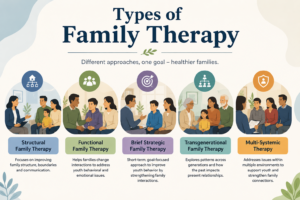
When exploring the different types of family therapy, it is important to understand that each approach offers a unique lens for viewing family dynamics and behavioural health.
Structural family therapy enhances family dynamics by clarifying boundaries and improving communication. This approach aims to resolve conflicts and address mental health issues by transforming family interactions. Techniques like family mapping and role-play are used to uncover and change dysfunctional patterns.
Functional Family Therapy is an evidence-based treatment model that helps families change their interactions to address behavioural or emotional issues in youth and young adults. FFT views family dynamics through a relational lens, acknowledging that families develop unique interaction patterns and meanings.
Brief Strategic Family Therapy is a short-term structural family systems framework to improve a youth’s behaviour problems by improving family interactions. The target population in general is children and adolescents between 8 and 17 years of age displaying or at risk for developing behaviour problems, including substance abuse
Transgenerational or intergenerational family therapies typically attend to dynamics across more than two generations. Transgenerational therapies are more interested in how the past affects the present. These therapies are not interested in learning about individual pathology. Rather, they are interested in how families, across generations, develop patterns of behaving and responding to stress in ways that prevent healthy development in their members and lead to predictable problems.
Multi-Systemic Therapy is a family therapy programme which works with children aged 10-17 and their families when the children are at risk of being placed in custody or care. It aims to promote positive family relationships, support the child to engage in education and training, tackle problems like substance use, and protect the child against involvement in crime and violence.
The Five Core Principles Of Family Therapy
The five core principles of family therapy are:
Systems Thinking
In this principle, the family is viewed as a system where every member’s behaviour is interdependent. A change in one part affects the whole system.
Focus on Interactional Dynamics
In this principle, therapy concentrates on exploring and restructuring dysfunctional, repetitive interaction patterns between members rather than exploring individual pathology.
Circular Causality
This principle asserts that rather than blaming one person for causing a problem, one should focus on how family members act in feedback loops where behaviours reinforce each other.
Empowerment & Strength Mobilisation
In this principle, therapists identify and mobilise the family’s internal strengths and functional resources to solve problems, rather than acting as a top-down expert.
Structural Change and Boundary Setting
This principle’s therapy aims to clarify boundaries between subsystems (parents, children, extended family) to create a more functional, balanced, and stable family structure.
Family Counsellor Online: What To Expect?
In-person therapy includes therapist-facilitated conversations that go through your emotional and mental health, any difficulties or issues you’re experiencing, and your development and progress. Therapists typically schedule individual sessions once a week for 40 or 60-minute time blocks.
During online therapy sessions, you meet with your therapist remotely. These therapies are also referred to as telepsychology or teletherapy; these online sessions mimic in-person therapy, except you won’t travel to your therapist’s office. Counselling online adheres to the same scheduling formats as traditional therapy. You regularly attend appointments that last about 40-60 minutes.
“Family therapy website”
When searching for family therapy online, look for platforms that prioritise HIPAA-compliant video software to ensure your family’s privacy is protected. Most reputable sites will offer a brief meet and greet or consultation to ensure the counsellor’s style matches your family’s personality.
How To Find The Right Family Counselling Services?
These are the steps to look over to find the right family counselling services:
Step 1: The first and main step in finding the right family counselling services is identifying your family’s specific needs and goals. Acknowledge to yourself why you are seeking therapy so that you will search for a specialist rather than a generalist.
Step 2: After acknowledging your need, research qualified professionals with specific training in family systems. Ensure they are a Licensed Marriage and Family Therapist (LMFT), Licensed Clinical Social Worker (LCSW), or licensed psychologist.
Step 3: Consequently, evaluate the therapist’s approaches and style. Different therapists use different techniques, such as Structural, Strategic, Systemic, or Cognitive-Behavioral family therapy. Match their method to the issue. If you need help with practical, behaviour-based solutions, look for structural or strategic therapy.
Step 4: Before starting the therapy, schedule initial consultations with the therapist. Most therapists offer a brief initial consultation or phone call. Use this “test run” to assess compatibility and ask these Key Questions: What is your experience with issues like ours? How do you involve children in the process? What is your approach to handling secrets or separate, individual conversations?
Step 5: After finding a potential match, review practical logistics to ensure consistent attendance. Check if they accept your insurance or offer a sliding-scale fee for out-of-pocket payments, and confirm they have hours that fit your family’s schedule, as many therapists only run family counselling center and do not do therapy virtually.
Is Family Therapy Effective? What the Research Says
Decades of clinical research confirm that family therapy is a highly effective gold standard for treating mental health and relationship issues. Unlike individual therapy, which focuses on the person in isolation, family-based interventions address the environment, which often leads to more permanent change.
For Children & Adolescents: Research consistently shows that family therapy is superior to talk therapy alone for treating behavioural problems, eating disorders, and depression in youth.
For Couples: Studies indicate that roughly 70% to 75% of couples who engage in therapy see a significant improvement in their relationship satisfaction. Even more promising, these benefits tend to last long-term because the couple learns a new shorthand for resolving future conflicts.
For Substance Abuse: When a family is involved in a loved one’s recovery, the success rates for maintaining sobriety increase dramatically. The family learns to stop enabling behaviours and starts providing the specific type of accountability that drives recovery.
Conclusion
Building a stronger, more resilient family doesn’t mean you have to have all the answers; it just means you’re willing to ask the right questions together. Whether you are navigating a major life transition, healing from past trauma, or simply looking to break old patterns of communication, professional support provides the roadmap to a more peaceful home.
You don’t have to navigate these complexities in isolation. If you’re ready to take the first step toward a healthier family dynamic, explore our specialised family counselling services or book a consultation today to find the right fit for your unique needs.
Every family faces challenges, but lasting change begins with open communication and the right support. Our mental health counselors in Rhode Island RI help families navigate life transitions, resolve conflicts, heal from past trauma, and build healthier relationships in a safe, supportive environment.
Frequently Asked Questions
Q1. What is the primary goal of family therapy?
The primary goal is to improve the family’s overall “health” by enhancing communication, resolving deep-seated conflicts, and creating a supportive home environment. It aims to give families the tools to solve future problems independently without needing a therapist’s intervention.
Q2. What are the five core principles of family therapy?
The five principles include: 1) Systems Thinking (the family is a unit), 2) Circular Causality (actions are chain reactions), 3) Neutrality (the therapist doesn’t take sides), 4) Homeostasis (identifying patterns that resist change), and 5) Self-Correction (empowering the family to adjust their own behaviours).
Q3. Why would family therapy be avoided (Red Flags)?
Family therapy should be avoided in cases of active domestic violence where a member’s safety is at risk, or if one member is being forced to attend against their will. It is also ineffective if one member has an untreated severe mental health crisis that prevents safe participation.
Q4. How does family therapy differ from individual therapy?
While individual therapy focuses on a person’s internal thoughts and history, family therapy focuses on the relationships and patterns between people. In family therapy, the “patient” is the relationship itself, rather than any one specific individual.