

Couples therapy is a form of psychotherapy that helps two partners improve communication, resolve conflict, rebuild trust, and strengthen their relationship. A licensed couples therapist guides both people through structured conversations that uncover unhealthy patterns and teach practical skills for creating change.
If you’ve been wondering how does couples therapy work, here’s the process at a glance:
- Understand the relationship and its challenges
- Identify recurring patterns and communication problems
- Set clear goals together
- Learn and practice new relationship skills
- Apply those skills outside therapy
- Build healthier ways of connecting long-term
What Is Couples Therapy, Exactly?
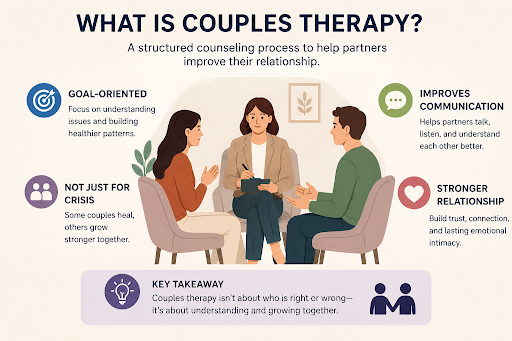
What is couples therapy? It’s a structured form of counseling designed to help partners improve their relationship.
Many people assume therapy is simply talking about problems. In reality, therapy is goal-oriented and guided by a trained professional. Sessions focus on understanding what’s happening beneath recurring arguments, emotional distance, trust issues, and communication breakdowns.
You may also hear it called:
- Couples counseling
- Marriage counseling
- Relationship therapy
In practice, these terms are often used interchangeably.
A key misconception is that therapy is only for couples in crisis.
That’s not true.
Some couples seek support after a betrayal or major conflict. Others come to therapy because they want to strengthen their relationship before problems become harder to address.
In couple therapy in psychology, the focus isn’t deciding who is right or wrong. The focus is understanding how the relationship functions and helping both partners create healthier patterns.
That’s also why many people searching for what is couple counseling are surprised to learn that therapy often feels more practical than they expected.
Read More Here: Therapy for Mental Health Issues
How Does Couples Therapy Actually Work?
People often imagine therapy as sitting on a couch and discussing feelings for an hour.
The reality is far more structured.
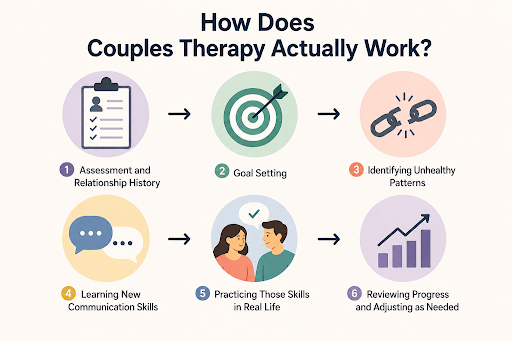
When asking how does couples therapy work, the process usually looks like this:
- Assessment and relationship history
- Goal setting
- Identifying unhealthy patterns
- Learning new communication skills
- Practicing those skills in real life
- Reviewing progress and adjusting as needed
Read More Here: Why Your Doctor Treats the Disease
The First Session: Assessment and Goals
The first session focuses on understanding the relationship.
Your therapist will explore:
- What brought you to therapy
- How long the issue has been present
- Relationship history
- Strengths within the relationship
- Areas where both partners feel stuck
Each person’s perspective matters.
The therapist isn’t collecting evidence to decide who is right. They’re looking for patterns that may be keeping both partners trapped in the same cycle.
Goals are also established early.
For one couple, the goal may be rebuilding trust. For another, it may be reducing conflict or improving communication.
What Happens in Ongoing Sessions?
Most sessions last between 50 and 60 minutes and occur weekly or every other week.
Over time, therapists begin identifying recurring interaction patterns.
A common example might look like this:
One partner raises a concern.
The other becomes defensive.
The first partner pushes harder.
The second partner withdraws.
The conversation ends with both people feeling unheard.
This pattern repeats again and again.
A skilled couples therapist helps both people recognize these cycles and understand what keeps them going.
Sessions often include:
- Active listening exercises
- Emotional validation
- Communication techniques
- Structured conversations
- Conflict resolution strategies
These are practical couple therapy techniques, not simply discussions about problems.
Homework and Real-World Practice
The real work happens between sessions.
Therapy creates awareness. Practice creates change.
Many therapists assign exercises designed to help couples apply what they’re learning in daily life.
One example is the 5-5-5 method:
- One partner speaks for five minutes
- The other listens without interrupting
- Roles switch for five minutes
- Both spend five minutes discussing what they heard
Simple exercises like this help couples build new habits outside the therapy room.
For many couples, meaningful progress occurs within 12 sessions, though the timeline varies depending on goals and circumstances.
What Is Couples Therapy For?
People often assume therapy is only necessary when a relationship is falling apart.
That’s one reason many couples wait longer than they need to.
In reality, what is couples therapy for?
It’s designed to help couples navigate challenges that are difficult to resolve on their own.
Recurring arguments are one example. The topic changes, but the pattern stays the same.
Communication breakdown is another. One partner feels unheard. The other feels criticized. Both become frustrated.
Therapy can also help after:
- Infidelity
- Broken trust
- Emotional distance
- Major life transitions
- Parenting stress
- Financial pressure
Some couples seek therapy before marriage. Others come after decades together.
You do not need to be in crisis to benefit.
If issues involve children, parenting concerns, or extended family dynamics, family therapy online or family counseling may also complement couples therapy.
The Real Benefits of Couples Therapy
The most obvious benefit is improved communication.
Couples learn how to express concerns without immediately triggering defensiveness. Conversations become more productive because both people understand what is actually happening beneath the argument.
Another benefit is pattern recognition.
Many couples know they’re stuck. They just can’t see the pattern clearly enough to change it. Therapy helps name the cycle so both partners can stop reacting automatically.
Trust is another area where therapy helps.
Trust rarely returns because someone promises things will be different. It rebuilds through consistent actions, accountability, and new ways of communicating.
Emotional connection often improves too.
Many couples enter therapy focused on conflict. They leave realizing the deeper issue was disconnection.
One benefit rarely discussed is the impact on individual mental health.
Relationship stress affects anxiety, sleep, mood, and overall well-being.
Partners carrying unresolved anxiety frequently discover that couples sessions reveal individual struggles that deserve attention too. In some cases, therapy becomes the first step toward seeking additional therapy for anxiety or personal counseling.
The skills learned in therapy also extend beyond the relationship.
Communication, emotional regulation, and conflict management improve interactions with family, friends, and colleagues.
That’s why the long-term benefits of couples therapy often extend far beyond the original issue that brought a couple into treatment.
Does Couples Therapy Actually Work?
Yes. Research consistently shows that couples therapy helps many relationships improve.
Studies suggest that approximately 70% of couples experience meaningful improvement when working with a trained therapist.
That doesn’t mean every couple stays together.
And that’s not always the goal.
Sometimes therapy helps couples repair their relationship.
Sometimes it helps them gain clarity about what comes next.
Both outcomes can be valuable.
Approaches such as Emotionally Focused Therapy (EFT) and the Gottman Method have strong research support.
The biggest predictors of success include:
- Both partners participating honestly
- Consistent attendance
- Realistic expectations
- A therapist trained in relationship work
When people ask does couples therapy work, the answer is yes, but effort and engagement matter.
Therapy creates the opportunity for change. The couple still has to do the work.
What to Expect in Couples Therapy: Session by Session
What to expect couples therapy? Most couples move through a fairly predictable process.
- Sessions 1-2 focus on assessment, relationship history, and goal-setting.
- Sessions 3-6 focus on identifying patterns, understanding communication problems, and practicing new skills.
- Sessions 7-10 often involve deeper conversations about trust, emotional needs, attachment patterns, and long-standing relationship dynamics.
- Sessions beyond that focus on maintaining progress and helping couples become less dependent on therapy.
The first session often feels awkward.
That’s normal.
A therapist provides structure so neither partner dominates the conversation and both feel heard.
These stages mirror common stages in couple counselling in psychology, though every relationship moves at its own pace.
What NOT to Do in Couples Therapy
Couples therapy works best when both people approach it with the right mindset.
Don’t treat therapy like a courtroom.
The goal isn’t proving who is right.
Don’t hide important information from your therapist.
Therapy can only address what is actually discussed.
Don’t expect the therapist to take sides.
A good therapist focuses on the relationship dynamic, not assigning blame.
Don’t quit after two sessions because things still feel uncomfortable.
Change takes time.
And don’t use therapy as ammunition later.
Statements like “Even the therapist agreed with me” usually create more conflict and undermine the process.
Online Couples Counseling: Is It as Effective?
Research suggests that online couples counseling is comparable to in-person therapy for many relationship concerns.
For busy couples, virtual sessions often improve consistency because travel time disappears.
Online therapy works particularly well when:
- Schedules are difficult to coordinate
- One partner travels frequently
- Partners live in different locations
- Privacy concerns make office visits uncomfortable
The structure of therapy remains largely the same.
The difference is the format.
For concerns involving parenting, family conflict, or extended family dynamics, family therapy online may also be an effective option alongside couples work.
In situations involving severe domestic conflict, active trauma, or safety concerns, in-person therapy is usually recommended.
How to Find the Right Couples Therapist
Not every therapist specializes in relationship work.
When choosing a couples therapist, look for someone with training in approaches such as:
- Emotionally Focused Therapy (EFT)
- Gottman Method
- Relationship-focused CBT
Experience matters.
So does it fit.
A therapist should create structure, encourage accountability, and help both partners feel heard.
Be cautious of therapists who:
- Take sides quickly
- Rush to conclusions
- Lack a clear treatment process
Finding the right therapist sometimes takes more than one attempt.
That’s normal.
The quality of the therapeutic relationship often influences outcomes just as much as the techniques themselves.
If you’re thinking about couples therapy, the hardest step is often the first conversation. At Integrated Counseling Service, we provide in-person and online couples counseling for couples looking to improve communication, rebuild trust, and strengthen their relationship.
Reach out today to learn how therapy can help you move forward together.