Couple speaking with a therapist during a professional couples counseling session.

What Is Couples Therapy and How Does It Work?

Couples therapy is a form of psychotherapy that helps two partners improve communication, resolve conflict, rebuild trust, and strengthen their relationship. A licensed couples therapist guides both people through structured conversations that uncover unhealthy patterns and teach practical skills for creating change.

If you’ve been wondering how does couples therapy work, here’s the process at a glance:

  1. Understand the relationship and its challenges
  2. Identify recurring patterns and communication problems
  3. Set clear goals together
  4. Learn and practice new relationship skills
  5. Apply those skills outside therapy
  6. Build healthier ways of connecting long-term

What Is Couples Therapy, Exactly?
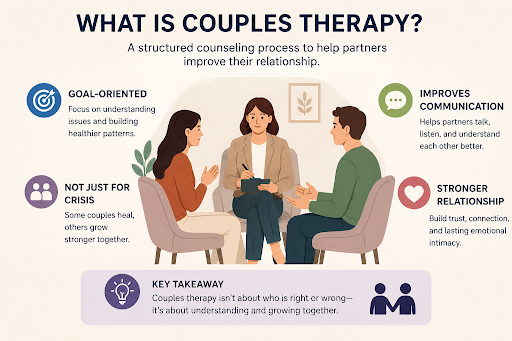
Couples therapy session helping partners improve communication and strengthen their relationship

What is couples therapy? It’s a structured form of counseling designed to help partners improve their relationship.

Many people assume therapy is simply talking about problems. In reality, therapy is goal-oriented and guided by a trained professional. Sessions focus on understanding what’s happening beneath recurring arguments, emotional distance, trust issues, and communication breakdowns.

You may also hear it called:

  • Couples counseling
  • Marriage counseling
  • Relationship therapy

In practice, these terms are often used interchangeably.

A key misconception is that therapy is only for couples in crisis.

That’s not true.

Some couples seek support after a betrayal or major conflict. Others come to therapy because they want to strengthen their relationship before problems become harder to address.

In couple therapy in psychology, the focus isn’t deciding who is right or wrong. The focus is understanding how the relationship functions and helping both partners create healthier patterns.

That’s also why many people searching for what is couple counseling are surprised to learn that therapy often feels more practical than they expected.

Read More Here:  Therapy for Mental Health Issues

How Does Couples Therapy Actually Work?
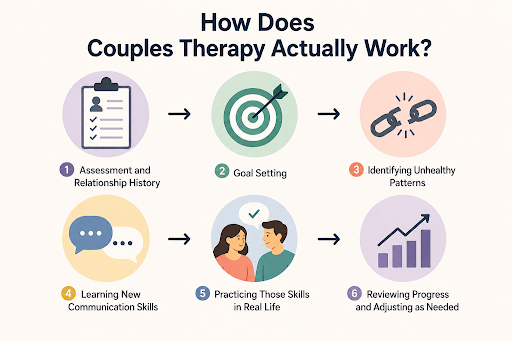
Infographic showing the six steps of couples therapy, including assessment, goal setting, communication, and progress review.

People often imagine therapy as sitting on a couch and discussing feelings for an hour.

The reality is far more structured.

When asking how does couples therapy work, the process usually looks like this:

  1. Assessment and relationship history
  2. Goal setting
  3. Identifying unhealthy patterns
  4. Learning new communication skills
  5. Practicing those skills in real life
  6. Reviewing progress and adjusting as needed

Read More Here:  Why Your Doctor Treats the Disease

The First Session: Assessment and Goals

The first session focuses on understanding the relationship.

Your therapist will explore:

  • What brought you to therapy
  • How long the issue has been present
  • Relationship history
  • Strengths within the relationship
  • Areas where both partners feel stuck

Each person’s perspective matters.

The therapist isn’t collecting evidence to decide who is right. They’re looking for patterns that may be keeping both partners trapped in the same cycle.

Goals are also established early.

For one couple, the goal may be rebuilding trust. For another, it may be reducing conflict or improving communication.

What Happens in Ongoing Sessions?

Most sessions last between 50 and 60 minutes and occur weekly or every other week.

Over time, therapists begin identifying recurring interaction patterns.

A common example might look like this:

One partner raises a concern.

The other becomes defensive.

The first partner pushes harder.

The second partner withdraws.

The conversation ends with both people feeling unheard.

This pattern repeats again and again.

A skilled couples therapist helps both people recognize these cycles and understand what keeps them going.

Sessions often include:

  • Active listening exercises
  • Emotional validation
  • Communication techniques
  • Structured conversations
  • Conflict resolution strategies

These are practical couple therapy techniques, not simply discussions about problems.

Homework and Real-World Practice

The real work happens between sessions.

Therapy creates awareness. Practice creates change.

Many therapists assign exercises designed to help couples apply what they’re learning in daily life.

One example is the 5-5-5 method:

  • One partner speaks for five minutes
  • The other listens without interrupting
  • Roles switch for five minutes
  • Both spend five minutes discussing what they heard

Simple exercises like this help couples build new habits outside the therapy room.

For many couples, meaningful progress occurs within 12 sessions, though the timeline varies depending on goals and circumstances.

What Is Couples Therapy For?

People often assume therapy is only necessary when a relationship is falling apart.

That’s one reason many couples wait longer than they need to.

In reality, what is couples therapy for?

It’s designed to help couples navigate challenges that are difficult to resolve on their own.

Recurring arguments are one example. The topic changes, but the pattern stays the same.

Communication breakdown is another. One partner feels unheard. The other feels criticized. Both become frustrated.

Therapy can also help after:

  • Infidelity
  • Broken trust
  • Emotional distance
  • Major life transitions
  • Parenting stress
  • Financial pressure

Some couples seek therapy before marriage. Others come after decades together.

You do not need to be in crisis to benefit.

If issues involve children, parenting concerns, or extended family dynamics, family therapy online or family counseling may also complement couples therapy.

The Real Benefits of Couples Therapy

The most obvious benefit is improved communication.

Couples learn how to express concerns without immediately triggering defensiveness. Conversations become more productive because both people understand what is actually happening beneath the argument.

Another benefit is pattern recognition.

Many couples know they’re stuck. They just can’t see the pattern clearly enough to change it. Therapy helps name the cycle so both partners can stop reacting automatically.

Trust is another area where therapy helps.

Trust rarely returns because someone promises things will be different. It rebuilds through consistent actions, accountability, and new ways of communicating.

Emotional connection often improves too.

Many couples enter therapy focused on conflict. They leave realizing the deeper issue was disconnection.

One benefit rarely discussed is the impact on individual mental health.

Relationship stress affects anxiety, sleep, mood, and overall well-being.

Partners carrying unresolved anxiety frequently discover that couples sessions reveal individual struggles that deserve attention too. In some cases, therapy becomes the first step toward seeking additional therapy for anxiety or personal counseling.

The skills learned in therapy also extend beyond the relationship.

Communication, emotional regulation, and conflict management improve interactions with family, friends, and colleagues.

That’s why the long-term benefits of couples therapy often extend far beyond the original issue that brought a couple into treatment.

Does Couples Therapy Actually Work?

Yes. Research consistently shows that couples therapy helps many relationships improve.

Studies suggest that approximately 70% of couples experience meaningful improvement when working with a trained therapist.

That doesn’t mean every couple stays together.

And that’s not always the goal.

Sometimes therapy helps couples repair their relationship.

Sometimes it helps them gain clarity about what comes next.

Both outcomes can be valuable.

Approaches such as Emotionally Focused Therapy (EFT) and the Gottman Method have strong research support.

The biggest predictors of success include:

  • Both partners participating honestly
  • Consistent attendance
  • Realistic expectations
  • A therapist trained in relationship work

When people ask does couples therapy work, the answer is yes, but effort and engagement matter.

Therapy creates the opportunity for change. The couple still has to do the work.

What to Expect in Couples Therapy: Session by Session

What to expect couples therapy? Most couples move through a fairly predictable process.

  • Sessions 1-2 focus on assessment, relationship history, and goal-setting.
  • Sessions 3-6 focus on identifying patterns, understanding communication problems, and practicing new skills.
  • Sessions 7-10 often involve deeper conversations about trust, emotional needs, attachment patterns, and long-standing relationship dynamics.
  • Sessions beyond that focus on maintaining progress and helping couples become less dependent on therapy.

The first session often feels awkward.

That’s normal.

A therapist provides structure so neither partner dominates the conversation and both feel heard.

These stages mirror common stages in couple counselling in psychology, though every relationship moves at its own pace.

What NOT to Do in Couples Therapy

Couples therapy works best when both people approach it with the right mindset.

Don’t treat therapy like a courtroom.

The goal isn’t proving who is right.

Don’t hide important information from your therapist.

Therapy can only address what is actually discussed.

Don’t expect the therapist to take sides.

A good therapist focuses on the relationship dynamic, not assigning blame.

Don’t quit after two sessions because things still feel uncomfortable.

Change takes time.

And don’t use therapy as ammunition later.

Statements like “Even the therapist agreed with me” usually create more conflict and undermine the process.

Online Couples Counseling: Is It as Effective?

Research suggests that online couples counseling is comparable to in-person therapy for many relationship concerns.

For busy couples, virtual sessions often improve consistency because travel time disappears.

Online therapy works particularly well when:

  • Schedules are difficult to coordinate
  • One partner travels frequently
  • Partners live in different locations
  • Privacy concerns make office visits uncomfortable

The structure of therapy remains largely the same.

The difference is the format.

For concerns involving parenting, family conflict, or extended family dynamics, family therapy online may also be an effective option alongside couples work.

In situations involving severe domestic conflict, active trauma, or safety concerns, in-person therapy is usually recommended.

How to Find the Right Couples Therapist

Not every therapist specializes in relationship work.

When choosing a couples therapist, look for someone with training in approaches such as:

  • Emotionally Focused Therapy (EFT)
  • Gottman Method
  • Relationship-focused CBT

Experience matters.

So does it fit.

A therapist should create structure, encourage accountability, and help both partners feel heard.

Be cautious of therapists who:

  • Take sides quickly
  • Rush to conclusions
  • Lack a clear treatment process

Finding the right therapist sometimes takes more than one attempt.

That’s normal.

The quality of the therapeutic relationship often influences outcomes just as much as the techniques themselves.

If you’re thinking about couples therapy, the hardest step is often the first conversation. At Integrated Counseling Service, we provide in-person and online couples counseling for couples looking to improve communication, rebuild trust, and strengthen their relationship. 

Reach out today to learn how therapy can help you move forward together.

Book a session for couples therapy today.

Book An Appointment →

Read More
The 5 Steps of Anger Management (And How to Use Them

The 5 Steps of Anger Management (And How to Use Them)

What is anger management? It’s a set of skills that helps you respond to anger differently instead of letting anger control your actions. The good news is that these skills can be learned, practiced, and improved over time.

If you’ve ever wondered, “How do you manage your anger?”, the answer usually comes down to five core steps:

  1. Recognize your warning signs
  2. Step away before you react
  3. Use breathing or grounding techniques
  4. Reframe the thought fueling the anger
  5. Express the feeling constructively

These five steps form the foundation of effective anger management and can help anyone who is dealing with anger issues.

What Is Anger Management?

Many people think anger management means suppressing anger.

It doesn’t.

Anger itself isn’t the problem. Everyone gets angry. The challenge is what happens next.

Do you react immediately? Do you say things you regret? Do small frustrations turn into major conflicts?

That’s where anger management comes in.

At its core, what is anger management really about? It’s learning how to change your response to anger. Instead of acting on the first impulse, you develop skills that allow you to pause, think clearly, and choose how to respond.

Research on Cognitive Behavioral Therapy (CBT) shows that changing thoughts and behaviors can significantly reduce anger-related problems. Anger management uses many of these same principles.

The goal isn’t to stop feeling angry.

The goal is to handle anger in a way that doesn’t damage your relationships, work, or well-being.

The 5 Steps of Anger Management

Anger often feels sudden.

In reality, it usually follows a sequence. Learning to interrupt that sequence is one of the most effective ways to regain control.

Step 1: Recognize Your Anger Warning Signs

Anger rarely appears without warning.

Your body often notices it before your mind does.

Common signs include:

  • A racing heart
  • Tight shoulders
  • A clenched jaw
  • Increased tension
  • Rapid thoughts

Pay attention to these signals.

One helpful strategy is “mood mapping.” Rate your anger on a scale from 1 to 10 throughout the day.

At a 3 or 4, you still have options.

At a 9 or 10, clear thinking becomes much harder.

Many people dealing with anger issues only notice their anger once it has already reached a breaking point. Learning to catch it earlier changes everything.

Step 2: Step Away Before You React

One of the simplest anger management skills is creating distance.

That may mean:

  • Leaving the room
  • Taking a walk
  • Ending a conversation temporarily

This isn’t avoidance.

It’s a reset.

When anger rises, your nervous system enters a stress response. During that state, problem-solving and communication become more difficult.

Giving yourself 10 to 20 minutes allows your body to calm down before you respond.

People often ask how to calm down anger issues quickly.

Creating space before reacting is one of the most effective answers.

Step 3: Use Breathing or Grounding to Calm Down

Anger affects the body as much as the mind.

That’s why physical techniques can be surprisingly effective.

Try diaphragmatic breathing:

  • Inhale slowly for four seconds
  • Hold for four seconds
  • Exhale for six seconds

Repeat several times.

Another option is grounding.

Focus on:

  • Five things you can see
  • Four things you can touch
  • Three things you can hear

These techniques help shift attention away from the trigger and back into the present moment.

If you’ve been wondering how can control anger, start with the body first. A calmer body often leads to a calmer mind.

Step 4: Reframe the Thought That’s Fueling the Anger

Anger is often intensified by the story you’re telling yourself about the situation.

For example:

“This is ruining my life.”

“This always happens.”

“They did this on purpose.”

These thoughts increase emotional intensity.

Instead, try asking:

  • Is there another explanation?
  • Am I assuming intent?
  • Am I exaggerating the consequences?

A more balanced thought might be:

“This is frustrating, but I can handle it.”

This process is a core part of anger management therapy and CBT-based treatment. The goal isn’t positive thinking. The goal is accurate thinking.

Step 5: Express the Feeling Constructively

Once you’ve calmed down, address the issue directly.

Many people swing between two extremes:

  • Exploding
  • Staying silent

Neither approach solves the problem.

Constructive communication sounds different.

Instead of:

“You never listen.”

Try:

“I felt frustrated when I didn’t feel heard.”

This keeps the conversation focused on the issue instead of turning it into an attack.

Research also shows that venting repeatedly often increases anger rather than reducing it.

The goal isn’t simply expressing anger.

It’s expressing it in a way that creates change.

What Are the 4 C’s of Anger Management?

The 4 C’s offer another useful framework for managing anger.

Cool Down: Give your mind and body time to settle before responding.

Consider: Think about what triggered the anger and whether your interpretation is accurate.

Communicate: Express your concerns clearly and respectfully.

Compromise: Look for solutions instead of focusing only on being right.

These are practical tips for anger management that can be applied in everyday situations, especially during conflict.

Anger as a Secondary Emotion: What’s Really Going On?

One reason anger can be difficult to manage is that it isn’t always the primary emotion.

Often, anger is the emotion that appears on the surface.

Underneath it, something else may be happening.

Consider these examples:

  • Anger after criticism may actually be hurt.
  • Anger during an argument may be fear of rejection.
  • Anger after being ignored may be a feeling of disrespect.
  • Anger following a breakup may be grief.

Understanding this changes how you approach dealing with anger.

Instead of asking:

“Why am I so angry?”

You begin asking:

“What is this anger protecting?”

This is often where therapy becomes valuable.

The same principle applies to anxiety. Many people who seek therapy for anxiety discover that fear, stress, and uncertainty are influencing how they react emotionally.

It’s one example of how individual therapy helps anxiety and anger at the same time. When you understand what’s happening underneath the surface, emotional reactions become easier to manage.

Tips for Anger Management That Work Long-Term

Managing anger isn’t only about what you do in the moment.

Your daily habits matter too.

Sleep plays a major role. People who are sleep-deprived tend to react more strongly to frustration and stress.

Physical activity can also help. Exercise reduces tension and provides a healthy outlet for emotional energy.

Tracking patterns is another useful strategy. Notice when anger appears most often. Are certain people, situations, or times of day involved?

One habit worth avoiding is repeated venting.

Talking about a problem can be helpful.

Reliving the same anger repeatedly often keeps it active.

These small adjustments may not seem dramatic, but over time they can make a significant difference for people looking for tips for anger management and wondering how to get rid of anger problems.

How to Get Rid of Anger Problems for Good

People often search for ways to permanently solve anger issues.

The reality is that anger isn’t something you eliminate.

It’s something you learn to manage effectively.

Professional support may be worth considering if anger is:

  • Damaging relationships
  • Creating problems at work
  • Affecting your physical health
  • Leading to regret after conflicts

This is where therapy can help.

CBT-based anger management therapy focuses on identifying triggers, changing thought patterns, and developing healthier responses.

Anger and anxiety also frequently overlap. People receiving therapy for anxiety often discover that reducing stress improves their ability to manage frustration and conflict.

At Integrated Counseling Services, we provide mental health services in Rhode Island for individuals working through anger, anxiety, relationship challenges, and life stressors.

If you’ve been struggling with dealing with anger issues, therapy can provide tools that self-help strategies alone may not offer.

Quick Ways to Reduce Anger Right Now

Deep Breathing: Slow your breathing to reduce the body’s stress response.

Cold Water: Splash cold water on your face or hold a cold object to help regulate your nervous system.

Write It Down: Put your thoughts on paper before discussing them with someone else.

Move Your Body: A short walk can reduce physical tension and improve perspective.

Reframe the Situation: Ask yourself whether the current thought is helping or intensifying the anger.

These techniques are useful when you’re wondering how to calm down anger issues or how can control anger in the moment.

When to Seek Anger Management Resources

The five steps of anger management are simple: recognize the warning signs, step away, calm your body, reframe your thoughts, and communicate effectively.

Like any skill, they improve with practice.

If anger continues affecting your relationships, work, or quality of life, additional support may help.

There are many anger management resources available, including books, support groups, online programs, and therapy. Professional counseling can provide personalized strategies based on your specific triggers and experiences.

Integrated Counseling Services offers evidence-based mental health services in Rhode Island for individuals, couples, and families. We help clients build healthier ways to manage anger, anxiety, stress, and relationship challenges.

If you’re ready to take the next step, call (401) 406-6377 or email IPS109@outlook.com to schedule an appointment.

Anger is a learned response. Managing it is a learnable skill.

Read More
Mental health therapist speaking with a client during a professional counseling session focused on emotional wellbeing, coping skills, and personal growth.

Therapy for Mental Health Issues

Deciding to seek therapy is a meaningful step  but with so many approaches and terminology, it can feel overwhelming before you even make that first call. This guide walks you through the most common types of therapy for mental health issues, who each one helps most, and how to identify the right starting point for your situation.

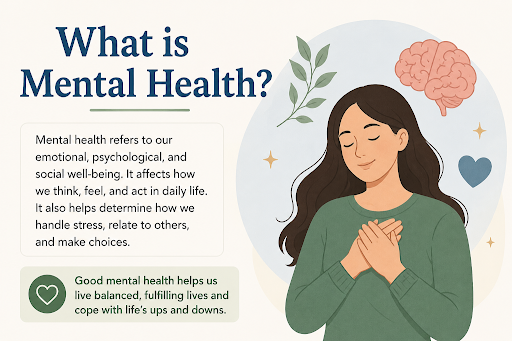
What Is Mental Health Therapy?

Mental health therapy  also called psychotherapy or talk therapy  is a structured, collaborative process between you and a trained professional. The goal is to help you understand your thoughts and emotions, shift patterns of behavior that aren’t serving you, and build practical coping skills for everyday life.

Therapy is not just “talking about your feelings.” It’s a goal-oriented process guided by evidence-based methods, tailored to your specific concerns and adjusted as your needs change. It’s also worth noting the distinction between therapy and psychiatry: therapists use conversation-based methods to support mental wellness, while psychiatrists are medical doctors who evaluate and prescribe psychiatric medication. Many people benefit from both working together  and if you’ve ever felt like your doctor is treating your symptoms without addressing the full weight of what you’re carrying, this piece on why doctors treat disease but not the person is worth a read.

Most therapists don’t apply a single rigid method  they draw on a combination of approaches based on what you’re experiencing and what’s working.

Mental health concept illustration showing a calm person with brain and wellness icons.

Read More Here: What Is Family Therapy

Different Types of Therapy for Mental Health Issues

Below are the most widely practiced and evidence-supported forms of therapy. Each one has a different focus and works best for different situations  understanding the distinctions helps you have a more informed conversation with a potential therapist.

Most Widely Used

1. Cognitive Behavioral Therapy (CBT)

What it is: CBT is based on the idea that your thoughts, feelings, and behaviors are interconnected. When negative or distorted thought patterns take hold  “I always fail,” “No one likes me”  they influence how you feel and how you act. CBT helps you identify those patterns and actively reframe them into more realistic, balanced ones.

Working one-on-one with your therapist through individual counseling, you’ll explore the thoughts that lead to self-destructive feelings and actions, then learn techniques to interrupt and change those cycles. It’s structured, practical, and goal-oriented  sessions involve active exercises, not just reflection.

Best For

Anxiety disorders, depression, OCD, phobias, panic attacks

Typical Duration

12–20 sessions (short-to-medium term)

What to Expect

Structured sessions with homework exercises between appointments

Good to Know

Often combined with other therapies; evidence base is among the strongest of any approach

2. Dialectical Behavior Therapy (DBT)

What it is: Originally developed from CBT, DBT was designed specifically for people who experience emotions intensely and struggle to regulate them. Where CBT focuses on changing thoughts, DBT adds a layer: learning to accept difficult emotions as they are, while also building skills to manage them. The word “dialectical” refers to this balance of acceptance and change at the same time.

DBT teaches four core skill sets: mindfulness (staying present), distress tolerance (surviving a crisis without making it worse), emotion regulation (understanding and managing strong feelings), and interpersonal effectiveness (communicating needs without damaging relationships).

Best For

Borderline personality disorder, self-harm, intense emotional dysregulation, severe trauma, suicidal ideation

Typical Duration

6 months to 1 year; often includes group skills training alongside individual sessions

What to Expect

Both individual therapy and structured group sessions teaching specific skills

Good to Know

Particularly effective for people with multiple co-occurring mental health conditions

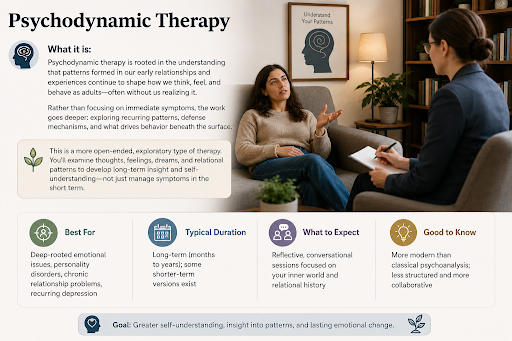
3. Psychodynamic Therapy

Psychodynamic therapy session helping a client understand deep-rooted emotional issues, relationship patterns, and personal growth.

What it is: Psychodynamic therapy is rooted in the understanding that patterns formed in our early relationships and experiences continue to shape how we think, feel, and behave as adults  often without us realizing it. Rather than focusing on immediate symptoms, the work goes deeper: exploring recurring patterns, defense mechanisms, and what drives behavior beneath the surface.

This is a more open-ended, exploratory type of therapy. You’ll examine thoughts, feelings, dreams, and relational patterns to develop long-term insight and self-understanding, not just manage symptoms in the short term.

Best For

Deep-rooted emotional issues, personality disorders, chronic relationship problems, recurring depression

Typical Duration

Long-term (months to years); some shorter-term versions exist

What to Expect

Reflective, conversational sessions focused on your inner world and relational history

Good to Know

More modern than classical psychoanalysis; less structured and more collaborative

Read More Here: Is It Love or Obligation?

4. Humanistic / Person-Centered Therapy

What it is: Person-centered therapy operates from the belief that you have the capacity to grow, heal, and make wise decisions when given the right environment to do so. Rather than directing the process, the therapist provides unconditional positive regard, a non-judgmental, empathetic space in which you lead the conversation and discover your own answers.

This approach emphasizes your inherent worth and potential rather than diagnosing what’s “wrong.” It’s particularly effective for those who have felt judged, misunderstood, or dismissed.

Best For

Low self-esteem, identity struggles, life transitions, personal growth, grief

Typical Duration

Flexible; can be short- or long-term depending on goals

What to Expect

Warm, client-led sessions; therapist reflects and supports rather than prescribes

Good to Know

Often integrated into other therapy styles; works well alongside CBT or psychodynamic approaches

Trauma-Specialized

5. Trauma-Focused Therapy (EMDR & TF-CBT)

What it is: Traumatic experiences  whether a single event or years of chronic stress  can get stuck in the nervous system in ways that normal conversation can’t always reach. Trauma-focused therapies are specifically designed to help the brain process and integrate those memories so they lose their emotional charge.

EMDR (Eye Movement Desensitization and Reprocessing) uses bilateral stimulation  typically guided eye movements  to help the brain reprocess traumatic memories the way it would naturally during REM sleep. Trauma-Focused CBT (TF-CBT) combines cognitive techniques with gradual, controlled exposure to trauma-related material in a safe therapeutic environment.

Best For

PTSD, childhood trauma, sexual or physical abuse, grief, accident survivors, combat veterans

Typical Duration

8–25 sessions for EMDR; longer for TF-CBT depending on complexity

What to Expect

Structured protocols; may feel different from traditional talk therapy  that’s intentional

Good to Know

Traumatic experiences can freeze emotional development; processing them is essential, not optional

6. Interpersonal Therapy (IPT)

What it is: IPT focuses specifically on the quality of your relationships and how they affect your mental health  and vice versa. It’s based on the understanding that depression, anxiety, and other conditions often emerge or worsen in the context of relationship problems, grief, role transitions, or unresolved conflict.

You’ll examine your social interactions, identify negative communication patterns, and learn to express your needs and emotions more effectively. IPT is structured and time-limited, making it a good fit for people who want a clear framework and a defined endpoint.

Best For

Depression linked to relationship issues, grief, major life changes, social isolation

Typical Duration

12–16 sessions (short-term, structured)

What to Expect

Clear goals set early; consistent focus on relationships and communication each session

Good to Know

One of the most researched short-term therapies for depression

Struggling with whether a relationship is giving as much as it’s taking? This may resonate: Is It Love or Obligation?

7. Solution-Focused Brief Therapy (SFBT)

What it is: Unlike approaches that explore the root causes of problems, SFBT focuses entirely on where you want to go  not where you’ve been. The therapist helps you identify strengths and coping skills you already have, and builds on those to move you toward your goals. The past is only relevant if it contains something useful for the future.

SFBT is particularly effective for people who feel they have the internal resources to cope but aren’t sure how to activate them. Sessions are practical and forward-focused.

Best For

Goal-oriented individuals, situational stress, people who prefer a practical approach

Typical Duration

6–10 sessions (brief by design)

What to Expect

Conversations focused on desired outcomes and what’s already working in your life

Good to Know

Works best for those with a stable foundation; not ideal as a standalone for complex trauma

8. Motivational Enhancement Therapy (MET)

What it is: MET is designed for people who feel ambivalent about change  who know on some level that they need help, but aren’t yet convinced or ready to commit to it. Rather than telling you what to do differently, the therapist helps you explore your own values and goals, and gently guides you to your own conclusions about what needs to change and why.

The change impulse comes from within  the therapist, facilitates, not directs. This makes MET uniquely effective for situations where resistance or reluctance is part of the presenting challenge.

Best For

Addiction and substance use, eating disorders, people resistant to traditional therapy

Typical Duration

1–4 sessions (often used as an entry point before transitioning to another approach)

What to Expect

Reflective conversations; therapist listens more than advises; no pressure to commit immediately

Good to Know

Commonly paired with CBT or addiction-specific programs for sustained results

9. Somatic / Body-Based Therapy

What it is: Somatic therapy recognizes something that traditional talk therapy sometimes overlooks: trauma, stress, and emotional pain are not just mental events; they are stored physically in the body. Tension, chronic pain, shallow breathing, and physical numbness can all be expressions of psychological distress.

Somatic approaches use breathwork, body awareness exercises, and mindful movement to help you tune into physical sensations and release stored emotional tension. The body becomes part of the healing process, not just a container for it.

Best For

Chronic trauma, anxiety with physical symptoms, chronic pain, stress-related illness

Typical Duration

Varies widely; often integrated into other approaches rather than used alone

What to Expect

A therapist who pays attention to body language, posture, and physical sensations alongside verbal content

Good to Know

Particularly useful when talk therapy alone hasn’t fully resolved trauma symptoms

Who Can Benefit from Therapy?

A common misconception is that therapy is only for people in crisis or those with a formal diagnosis. In reality, therapy is valuable across a much wider range of situations:

  • People experiencing anxiety, depression, trauma, grief, or burnout
  • Individuals navigating major life transitions  divorce, job loss, relocation, retirement
  • Those struggling with relationship conflict, communication patterns, or family dynamics
  • People who want to understand themselves better, build confidence, or work through past experiences
  • Anyone who feels persistently off, stuck, or like something isn’t quite right  even without a clear label

You don’t have to be at a breaking point to benefit from therapy. The earlier you engage with support, the more tools you have before a difficult period becomes a crisis. If you’ve been second-guessing whether the stress you’re feeling at work is normal or something worth addressing, this related read may help: Is It a Toxic Workplace or Am I Overreacting?

Individual, Group, and Family Therapy: What’s the Difference?

Beyond the therapeutic approach itself, the format of therapy matters too. There are three primary structures:

  • Individual therapy  One-on-one sessions between you and your therapist. The deepest form of personal work, with the full session dedicated to your specific concerns, history, and goals.
  • Group therapy  A therapist-led session with a small group of individuals, typically focused on a shared theme (anxiety, grief, addiction recovery, etc.). Group settings reduce isolation, provide peer perspective, and build interpersonal skills in a safe environment.
  • Couples and family therapy  Focuses on the relationship dynamic rather than one individual. Useful for communication breakdown, parenting conflicts, major life transitions affecting a family unit, or when one person’s mental health challenges ripple into family life. Learn more about our family therapy services or read our deeper explainer on what family therapy actually involves.

These formats are not mutually exclusive; many people attend individual therapy and a support group simultaneously, or transition between formats as their needs evolve. If you’re weighing which format makes the most sense for your situation, our guide on the difference between individual, couples, and family therapy breaks it down clearly.

Which Type of Therapy Is Right for Me?

The honest answer is that most therapists work integratively; they draw from multiple approaches based on what’s working for you. You don’t need to arrive with a specific method in mind. What matters is starting the conversation.

That said, the following quick-match framework can help orient your thinking:

If you’re dealing with… Consider starting with…
Anxiety, worry, or panic CBT or IPT
Depression (mild to moderate) CBT, IPT, or Person-Centered Therapy
Trauma or PTSD EMDR or Trauma-Focused CBT
Intense emotional dysregulation or self-harm DBT
Relationship or communication problems IPT or Couples Therapy / Family Therapy
Addiction or resistance to change MET (Motivational Enhancement Therapy)
Low self-esteem or identity concerns Person-Centered / Humanistic Therapy
Physical symptoms tied to stress or trauma Somatic Therapy
Goal-focused, prefer a practical short-term approach SFBT or CBT
Deep-rooted patterns or recurring life themes Psychodynamic Therapy


A good therapist will assess your needs early on and adjust their approach accordingly. The most important step is simply getting started  not picking the “perfect” method before your first session.

How to Choose the Right Level of Care

Therapy exists on a spectrum of intensity. Choosing the right level depends on how much your symptoms are affecting your ability to function day-to-day:

Mild Symptoms

Feeling off, anxious, or stressed but meeting your daily responsibilities. Standard outpatient therapy (weekly sessions) is the ideal starting point.

Moderate Symptoms

Difficulty focusing at work, maintaining relationships, or getting through the day. An Intensive Outpatient Program (IOP)  several hours of therapy per week  provides a stronger structure while you sleep at home.

Severe Symptoms

Unable to work, care for yourself, or feeling a loss of hope. Partial Hospitalization (day programs) or inpatient care provides a supervised, structured environment to stabilize.

Need Flexibility

Busy schedule, remote location, or prefer privacy at home. Telehealth therapy delivers the same quality of care through secure video sessions  available for individual, couples, and family formats.

What to Expect in Your First Therapy Session

The first session  often called an intake or evaluation  is less about diving into deep work and more about getting to know each other. Your therapist will ask about what brought you in, your history, current symptoms, and what you’re hoping to get out of therapy. You’ll have space to ask your own questions too.

A few things worth knowing before you go:

  • Confidentiality is a core principle. What you share stays between you and your therapist, with limited legal exceptions (such as imminent risk of harm to yourself or others).
  • Sessions typically run 50–60 minutes.
  • You won’t feel “fixed” immediately  and that’s completely normal. Therapy is a process, not an event. Most people begin to notice meaningful shifts after 4–8 sessions.
  • Fit matters. If after a few sessions you don’t feel a working connection with your therapist, it’s okay to say so  or to look for someone else. A strong therapeutic relationship is one of the strongest predictors of good outcomes.

Frequently Asked Questions About Therapy for Mental Health

How do I know if I need therapy?

If your thoughts, emotions, or behaviors are making it harder to function in daily life  at work, in your relationships, or in your own head  therapy is worth exploring. You don’t need a diagnosis or a crisis to start. Reaching out for an evaluation is always a reasonable first step.

How long does therapy take to work?

It depends on the type of therapy and the nature of your concerns. Short-term structured approaches like CBT or SFBT often show results within 8–16 sessions. Deeper work  processing longstanding trauma or complex patterns  may take months or longer. Your therapist should be able to give you a realistic sense of the timeline early on.

What is the difference between a therapist, psychologist, and psychiatrist?

Therapists (including licensed counselors, clinical social workers, and marriage and family therapists) provide talk therapy. Psychologists have doctoral-level training and can conduct psychological testing in addition to therapy. Psychiatrists are medical doctors who specialize in diagnosing mental health conditions and prescribing medication. Many people benefit from seeing a therapist and psychiatrist together.

Is therapy covered by insurance?

Many insurance plans cover mental health services, especially since the Mental Health Parity and Addiction Equity Act requires comparable coverage to physical health. Coverage varies by plan. It’s best to contact your provider directly or ask a practice to verify your benefits for you.

Can therapy be done online?

Yes. Telehealth therapy has expanded significantly in recent years and provides the same level of care, structure, and confidentiality as in-person sessions  just through a secure video platform. It’s an excellent option for people with busy schedules, limited transportation, or a preference for privacy at home. Ensure your provider is licensed in your state and uses a HIPAA-compliant platform.

What if therapy doesn’t help?

Therapy not working can mean different things: the approach may not be the right fit, the therapist-client relationship may need recalibrating, or additional support (like medication management alongside therapy) may be needed. It’s not a sign that you’re beyond help, it’s useful information. Talking openly with your therapist about what isn’t working is part of the process.

Do you accept Rhode Island insurance plans?

Coverage varies depending on your insurance provider and specific plan. We recommend contacting us directly so we can help verify your benefits and walk you through available options  including both in-person and telehealth sessions.

What is your typical wait time for an initial intake appointment?

Initial appointments are typically available within a few days to two weeks, depending on scheduling and the type of support you’re seeking. We aim to make the process as smooth and timely as possible. Reaching out is already the hardest part.

Ready to Start? We’re Here in Rhode Island.

Integrated Counseling Service provides individual, group, couples, and family therapy for adults across Pawtucket, RI and the surrounding Massachusetts area.

Whether you’re navigating anxiety, depression, relationship challenges, trauma, or a difficult life transition, we’ll help you identify the right starting point and build a care plan from there.

Schedule Your Intake Appointment →

Read More
What's the Best Type of Therapy for Depressio

What’s the Best Type of Therapy for Depression?

The most effective types of therapy for depression include Cognitive Behavioral Therapy (CBT), Interpersonal Therapy (IPT), Behavioral Activation (BA), Psychodynamic Therapy, and Mindfulness-Based Cognitive Therapy (MBCT).

Each approach works differently. Some focus on thought patterns, while others focus on relationships, behavior, or emotional experiences. If you’ve ever wondered how is depression treated, the answer depends on what’s contributing to your symptoms and what type of support fits your situation.

This guide covers:

  • Cognitive Behavioral Therapy (CBT)
  • Interpersonal Therapy (IPT)
  • Behavioral Activation (BA)
  • Psychodynamic Therapy
  • Mindfulness-Based Cognitive Therapy (MBCT)
  • Group Therapy and Peer Support
  • Treatment Beyond Therapy
  • Online vs. In-Person Therapy
  • How to Start Treatment

Types of Therapy for Depression

When people start researching therapies for depression, they often hope to find one treatment that works for everyone.

Depression doesn’t work that way.

One person may struggle with constant self-criticism. Another may feel depressed after a divorce, a loss, or a major life change. Someone else may find it difficult to get out of bed or stay engaged with daily life.

Different challenges require different approaches. That’s why several evidence-based therapies exist.

Cognitive Behavioral Therapy (CBT)

CBT is one of the most researched and widely recommended forms of therapy treatment for depression.

The approach focuses on the relationship between thoughts, emotions, and behavior.

Depression often influences how you interpret events. A setback at work may feel like proof that you’re failing. A disagreement may feel like evidence that people don’t care about you.

CBT helps you:

  • Identify unhelpful thought patterns
  • Examine whether those thoughts are accurate
  • Develop more balanced perspectives
  • Build healthier coping strategies

For example, instead of automatically accepting the thought, “Nothing ever works out for me,” CBT encourages you to look at the evidence and challenge the conclusion.

Research consistently shows strong outcomes for CBT. Clinical guidelines often recommend 16 to 20 sessions, and studies regularly report response rates between 50% and 60%.

It’s also considered one of the strongest options for people experiencing both depression and anxiety, making it a common answer when people ask about the best therapy for depression and anxiety.

CBT is available both online and in person.

Interpersonal Therapy (IPT)

Relationships play a major role in emotional well-being.

That’s the foundation of interpersonal therapy for depression.

This approach focuses on:

  • Grief and loss
  • Relationship conflict
  • Life transitions
  • Social isolation

Imagine depression developing after a divorce, retirement, relocation, or loss of a loved one. In situations like these, the issue isn’t always negative thinking. The issue may be the emotional impact of major changes in relationships and support systems.

IPT helps you:

  • Improve communication
  • Resolve relationship difficulties
  • Build stronger support networks
  • Adjust to life changes more effectively

Treatment typically lasts between 12 and 16 sessions and focuses on specific goals.

For people whose depression feels closely connected to relationships or major life events, IPT can be highly effective.

Behavioral Activation (BA)

Depression often creates a cycle that keeps itself going.

You feel low, so you stop doing things. Life becomes smaller. Activities that once provided structure, connection, or enjoyment disappear. Mood declines further.

Behavioral Activation focuses on breaking that cycle.

This form of behavioral therapy for depression is practical and action-oriented.

Rather than spending significant time analyzing thoughts, BA focuses on helping you:

  • Rebuild routines
  • Increase meaningful activities
  • Reconnect with people
  • Create small, achievable goals

One of the key principles of Behavioral Activation is that motivation often follows action, not the other way around.

You don’t wait to feel motivated before taking a step forward.

You take the step, and motivation often follows.

Research shows Behavioral Activation can be as effective as CBT for many people and is often delivered in fewer sessions.

Psychodynamic Therapy

Some people want more than symptom relief.

They want to understand why certain emotional patterns continue appearing throughout their lives.

Psychodynamic therapy focuses on:

  • Past experiences
  • Emotional conflicts
  • Relationship patterns
  • Unconscious beliefs

You may notice that the same themes keep appearing in different situations. Perhaps criticism affects you deeply. Maybe relationships follow a familiar pattern that leaves you feeling disappointed or disconnected.

Psychodynamic therapy explores those experiences and helps uncover the factors shaping them.

Unlike CBT, this approach is less structured and focuses more on insight and self-understanding.

Research supports psychodynamic therapy as an effective psychological treatment for depression and anxiety, particularly for persistent or recurring depression.

Mindfulness-Based Cognitive Therapy (MBCT)

Some people recover from depression but find themselves slipping back into familiar patterns months later.

MBCT was designed to help prevent that.

It combines mindfulness practices with cognitive therapy techniques.

The goal is not to stop thoughts from happening. The goal is to change how you respond to them.

Instead of immediately believing a thought like:

“I’m not good enough.”

You learn to notice it, acknowledge it, and step back from it.

MBCT helps develop:

  • Greater self-awareness
  • Emotional regulation
  • Recognition of early warning signs
  • Skills for preventing relapse

Clinical guidelines often recommend MBCT for people who have experienced three or more episodes of depression.

What Therapy Is Best for Depression?

There isn’t one therapy that’s best for everyone.

The better question is: What is contributing to your depression?

Different therapies are designed to address different challenges:

  • If you’re stuck in negative thought patterns and self-criticism, CBT is often a strong fit.
  • If depression began after a loss, divorce, relationship conflict, or major life transition, Interpersonal Therapy (IPT) may be more helpful.
  • If motivation has disappeared and daily activities feel overwhelming, Behavioral Activation is often recommended.
  • If the same emotional patterns keep showing up throughout your life and relationships, Psychodynamic Therapy may offer deeper insight.
  • If you’ve experienced multiple episodes of depression and want to prevent relapse, MBCT can help you recognize warning signs earlier.

A therapist can help determine which approach aligns best with your symptoms, goals, and personal history.

Group Therapy and Peer Support for Depression

One area often overlooked when discussing depression treatment is group support.

Individual therapy is valuable, but it isn’t the only option.

Group therapy allows people to learn new skills, share experiences, and receive support from others facing similar challenges.

Common formats include:

  • Group CBT
  • DBT skills groups
  • Depression support groups
  • Peer-led support communities

People often ask whether there is a group similar to AA for depression.

Yes.

Organizations such as the Depression and Bipolar Support Alliance (DBSA) and the National Alliance on Mental Illness (NAMI) provide peer-led support groups for people living with depression.

Depression can also affect relationships. Communication may become more difficult. Partners may struggle to understand what’s happening. Family members may feel unsure how to help.

In some situations, support from a family divorce therapist can be helpful when depression is connected to separation, divorce, or family conflict. Others may benefit from online couples counseling to improve communication and strengthen support within the relationship.

Treatment doesn’t always have to happen one-on-one.

How Is Depression Treated Beyond Therapy?

Therapy is one of the most effective treatments for depression, but it’s not the only one.

When people ask, what are depression treatments, several options may be considered.

These include:

  • Therapy
  • Medication
  • Lifestyle changes
  • Social support

Research consistently shows that therapy combined with medication is often more effective than either treatment alone for moderate to severe depression.

Common depression treatment medication options include antidepressants such as SSRIs.

Lifestyle factors also play an important role:

  • Regular physical activity
  • Consistent sleep habits
  • Reduced alcohol use
  • Balanced nutrition
  • Meaningful social connection

People searching for depression treatment naturally are often looking for alternatives to medication. Healthy lifestyle habits can support recovery, but they work best alongside professional treatment rather than as a replacement for it.

Key Concepts in Depression Therapy: The 3 C’s and 5 R’s

The 3 C’s

Catch It: Notice the negative thought as it appears.

Check It: Examine whether the thought is accurate and supported by evidence.

Change It: Replace the thought with a more balanced and realistic perspective.

These three steps form the foundation of many CBT techniques.

The 5 R’s

Response: Symptoms improve after treatment begins.

Remission: Symptoms become minimal or disappear.

Recovery: Remission continues over time.

Relapse: Symptoms return before full recovery is established.

Recurrence: A new depressive episode develops after recovery.

Understanding these stages helps explain why treatment doesn’t stop the moment symptoms improve.

Online Therapy vs. In-Person Therapy for Depression

Online therapy has become a widely used option for depression treatment.

Research shows that online CBT can be just as effective as in-person therapy for many individuals.

Benefits of online therapy include:

  • Greater flexibility
  • Easier scheduling
  • Reduced travel time
  • Increased access to care

In-person therapy may be a better fit when:

  • Symptoms are severe
  • Safety concerns are present
  • Crisis support is needed
  • You prefer face-to-face interaction

At Integrated Counseling Services, clients can access both virtual and in-person appointments through our mental health services Rhode Island community members rely on.

Online therapy also allows individuals to access support from home while maintaining consistency with treatment.

How to Deal with Depression: Starting Therapy

Learning how to deal with depression doesn’t begin with finding the perfect treatment.

It begins with reaching out for support.

You don’t need to know which therapy is right for you before scheduling an appointment. That’s part of the process.

A therapist can help you:

  • Understand what may be contributing to your depression
  • Explore treatment options
  • Develop realistic goals
  • Track progress over time

When searching for a therapist, consider:

  • Their experience treating depression
  • The therapy approaches they use
  • Whether they offer online and in-person sessions
  • Whether you feel comfortable speaking openly with them

At Integrated Counseling Services, we provide evidence-based mental health services Rhode Island residents can access both online and in person. Our therapists work with individuals facing depression, anxiety, relationship challenges, grief, and major life transitions.

If you’re ready to take the next step, call (401) 406-6377 or email IPS109@outlook.com to schedule an appointment.

Support is available. You don’t have to figure this out alone.

Read More
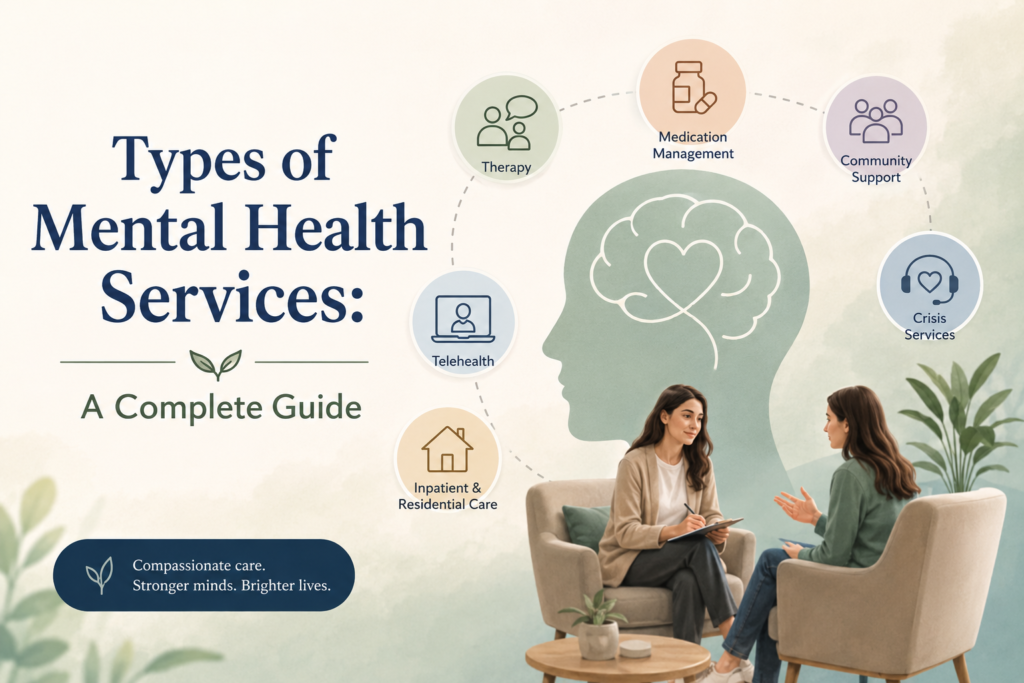
different types of mental health services including therapy, telehealth, crisis support, medication management, and inpatient care with a therapist counseling a patient.

Types of Mental Health Services: A Complete Guide

Mental health services include psychotherapy, medical management, community mental health services, hospital or residential treatment, crisis services, specialised services, and alternative therapy. These services provide essential support for your emotional and psychological well-being through their services and treatment provided by professionals who diagnose, treat, and provide medical treatment for different conditions.

Some of the common mental health conditions are depression, anxiety, and bipolar mood disorder. Each service provides different levels of care and support depending on an individual’s emotional, psychological, and behavioural health needs.

In this guide, you will get to know about different types of mental health services, things you should know to choose the right mental health services, and how you can find mental health services in Rhode Island.

The main types of mental health services at a glance

There are different types of mental health services provided by professionals such as psychiatrists, psychologists, community psychiatric nurses, social workers, and occupational therapists who work in a mental health team according to an individual’s needs.

  • Psychotherapy (Talk Therapy): This involves individual or group sessions with a professional to share behaviours, emotions, and coping skills.
  • Medication Management: It focuses on suggesting and monitoring the medical treatment of an individual.
  • Outpatient Programs: It involves providing structured, scheduled treatment to an individual at their home.
  • Inpatient and Residential Care: It offers 24/7 treatment in a hospital or specialised facility, and long-term recovery.
  • Crisis Intervention Services: It provides immediate, short-term support through hotlines, mobile teams, or urgent care in emergencies.
  • Community-Based Support: It includes support groups, case management, and rehabilitation services designed to help individuals in the local environment.

Outpatient mental health services

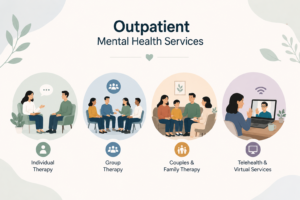
Illustration of outpatient mental health services including individual therapy, group counseling, family therapy, and telehealth support.

It is a type of mental health care that provides community-based services, which involve regular sessions with professional psychologists to focus on long-term wellness, symptom management, and personal growth without staying overnight in a hospital or facility, while you can maintain your daily routines. By providing these services, they ensure that mentally therapeutic resources are available to people at various stages of their mental health journey.

Individual therapy

Individual therapy, which is often called talk therapy, is a one-on-one process where a patient collaborates with a trained therapist regarding their personal concerns, involves diagnosing the problem and developing a care plan, and working while living at home. The session usually occurs once or twice a week for about 50 minutes. There are some common therapeutic approaches, such as cognitive behavioural therapy for changing negative thought patterns, dialectical behavioural therapy for emotion regulation, EMDR for trauma, and acceptance and commitment therapy for mindfulness. This therapy helps in managing severe stress, burnout, grief, anger, and low self-esteem.

Group therapy

This therapy involves one or more clinicians which helps in supporting a small group of individuals to share similar experiences, and everyone will get mutual support from people dealing with similar problems, and unlike individual therapy, it reduces isolation and offers interpersonal support. It is the best option for those who don’t want to feel isolated in their struggles or want to improve their interpersonal skills. It works for a wide range of psychiatric, emotional, and many other conditions, specifically depression and bipolar disorder.

Couples and family therapy

These services are designed for partners facing frequent arguments, healthy couples wanting to strengthen their bond, parents and children struggling with behavioural issues,  families having major life changes such as divorce, relocation, or a new baby, and individual support in a specific condition like depression, anxiety, or an eating disorder. While individual therapy only focuses on personal growth and self-awareness, this therapy ensures that improving communication and changes group patterns. You can expect a professional to have a neutral environment where the therapist will help to identify toxic patterns and resolve conflicts.

Telehealth and virtual mental health services

Virtual care has seen massive growth as it provides a therapy for those who don’t have access because they live in remote areas or have restrictive schedules. It is best for those individuals who want private mental health care at home in comfort or who have few symptoms of anxiety, depression, or ADHD. If you are looking for mental health services in Rhode Island, you have to ensure that the telehealth provider uses a HIPAA-compliant platform, and are licensed in your specific state, and has specialisation according to specific needs.

Why Your Doctor Treats the Disease but Not the Person Falling Apart Inside

Intensive outpatient and partial hospitalization programs

An intensive outpatient program is a high-quality treatment program for improving mental health, helping participants learn from others facing similar challenges, and supporting individuals while they can maintain daily responsibilities. This is designed for those individuals who need more than one hour of therapy per week while maintaining work or commitments. These programs typically involve 9 to 13 hours of treatment, which will last 5 to 6 weeks. The primary focus is on group therapy, individual sessions and medical management. It is best suited for drug & alcohol addiction, moderate depression, or an eating disorder that requires intensive therapy

A partial hospitalisation program is the high-intensive form of outpatient care and addiction treatment program where patients receive daily group therapy, individual psychotherapy, family therapy and medication management by a psychiatrist. It is a short-term program for 5 to 6 hours a day and five days a week, and it is often called a day treatment program in which no overnight staying is required. The level of care is designed for individuals with severe mental health disorders who are at risk of hospitalisation, and people needing an environment for recovery. 

Inpatient and residential mental health treatment

Inpatient care is the short-term and most intensive level of psychiatric service, designed for acute care within a hospital to stabilise dangerous symptoms. It takes place in a secure hospital ward where patients receive 24-hour care and nursing supervision. This is usually a short-term treatment, lasting 3 to 7 days, and the primary goal is to provide safety and immediate symptom reduction. It is best for individuals who are an immediate danger to themselves or others, or those experiencing a complete inability to care for their basic needs due to a mental health emergency.

Residential treatment is a treatment that provides a 24-hour, home-like environment for individuals with conditions like depression, bipolar disorder, and severe anxiety, and it focuses on long-term recovery and is designed for healing rather than emergency help. Residents provide a highly structured daily schedule of individual therapy, group work, and life-skills training. This treatment has a duration of 30 to 90 days, but some programs last longer. It is ideal for individuals with complex, chronic conditions such as severe PTSD, an eating disorder, or people who do not have a stable or supportive home environment to facilitate better recovery.

Community-based and crisis mental health services

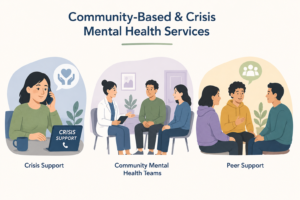
Crisis hotlines and mental health urgent care centres provide immediate, short-term support for individuals experiencing acute psychological distress. These organisations are typically run by non-profits or government agencies and staffed by trained counsellors. If someone is feeling overwhelmed, experiencing suicidal thoughts, or in the middle of a panic attack, they can use these services without a hospital visit 

Illustration showing crisis support, community mental health teams, and peer support services for mental health care.

Community mental health teams are groups including psychiatrists, nurses, and social workers who provide care to people with complex mental health needs living in the community. It is often run by the local government health department, and these teams offer counselling, medication management, and walk-in crisis services. They are ideal for individuals with chronic conditions like schizophrenia or bipolar disorder who require ongoing medical oversight to stay stable outside of a clinical facility.

Peer support involves a group of individuals who have experienced mental health challenges, providing mentorship and emotional support to others. These programs are often run by community organisations or advocacy groups like NAMI. It is best used as a supplement to professional therapy and focuses on empowering individuals and fostering social connections.  

Is It a Toxic Workplace or Am I Overreacting?

Mental health medication management

Medication management is a clinical service focused on the prescribing and monitoring of psychiatric drugs to manage symptoms. This care is provided by psychiatrists or psychiatric nurse practitioners. Unlike therapists, these providers evaluate the biological components of mental illness and provide medicine to ensure efficacy while minimising side effects. Here are some common types of psychiatric medications:

  • Antidepressants: It is used to balance neurotransmitters that affect mood and emotional response.
  • Anti-anxiety Medications: It is a fast-acting drugs that help to reduce the physical and mental symptoms of severe anxiety or panic.
  • Mood Stabilisers: It is primarily used to manage the high and lows associated with conditions like bipolar disorder.
  • Antipsychotics: It is designed to manage symptoms of psychosis, such as hallucinations or delusions, and are sometimes used to improve other treatments.

It is important to know that medication is a tool to be used alongside psychotherapy, not in place of it, because medication can stabilise a person’s biology, and therapy provides the long-term recovery to cure the problem.

How to choose the right mental health service

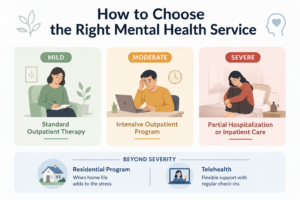
Infographic showing different mental health services based on symptom severity, including outpatient therapy, intensive outpatient programs, inpatient care, residential programs, and telehealth support.

  • Choosing the right service depends on how much your symptoms interfere with your ability to function in daily life. Here is the simple guide according to symptom severity:
  • Mild: If you are generally doing your responsibilities but feeling off, anxious, or stressed, standard outpatient therapy is the best starting point. It involves weekly sessions to build coping skills without disrupting your daily life.
  • Moderate: If you are having difficulty focusing at work, maintaining relationships, or getting through a day, an intensive outpatient program will provide a necessary boost. It involves several hours of therapy a week while sleeping in your own bed.
  • Severe: If you can’t work, care for yourself, or feel a loss of hope, a partial hospitalisation program or inpatient care is appropriate because it provides a safe, supervised environment to stabilise.
  • Beyond severity: If your home life is a main reason for you stressing, then a residential program might be better, and if you have a busy schedule but need constant check-ins, telehealth offers it in the most flexible way.

The Difference Between One-to-One Therapy, Couple Therapy, and Family Counseling

What is the 3-3-3 rule in mental health?

The 333 rule is an informal coping technique that can effectively manage anxiety when it feels particularly overwhelming. It involves observing 3 things you see, 3 sounds you hear, and moving 3 body parts. You can use it to redirect attention away from physical symptoms, to interrupt overthinking while in a crowded or stressful environment or before a big presentation or a difficult conversation, to regain emotional control.

Finding mental health services in Rhode Island

finding the right mental health services in the ocean state requires a practical approach. To find local providers, start with the Rhode Island Department of Behavioral Healthcare (BHDDH) database or use reputable insurance directories. When you are choosing between providers, you should consider your needs such as private practice offers specialized, consistent care with shorter wait times but may have higher cost and Community Care is best for comprehensive support, though it has high demand which can impact scheduling.

Choosing the right mental health service is a deeply personal decision that should reflect your unique history, current symptoms, and long-term goals. What works for one person may change as their needs evolve over time. If you’re feeling unsure of where to begin, reaching out for a professional evaluation can help clarify which level of care is best for you. Finding a practice that aligns with your values is the first step toward sustainable wellness.

Frequently Asked Questions

Do you accept my specific Rhode Island insurance plan?

Coverage for therapy services can vary depending on your insurance provider and plan. If you’re looking for individual therapy in Rhode Island or family counseling services, we recommend contacting us directly so we can help verify your benefits and explain available options. We’re happy to guide you through the process and answer questions about coverage for in-person or family therapy online sessions.

Are you currently taking new patients for my specific concern?

Yes, we welcome new clients for a range of concerns, including anxiety, depression, relationship stress, Family of origin issues, grief, life transitions, and therapy for family conflicts. We also provide support for concerns related to self-confidence, Career counseling, caregiving stress, and emotional overwhelm. Availability may vary depending on the type of support you’re seeking, but we’ll do our best to match you with the right therapist and appointment schedule.

What is your typical wait time for an initial intake appointment?

Initial appointments are usually available within a few days to two weeks, depending on scheduling and the type of service requested. We understand that reaching out for support can already feel difficult, so we aim to make the process as smooth and timely as possible. Whether you’re seeking individual therapy online, one-to-one therapy, or working with a counselor for family problems, we’ll help you get started with clarity and support.

Do you offer telehealth options for follow-up sessions?

Yes. We offer secure and convenient telehealth options for both new and existing clients. Individual therapy online, online couples counseling, and family therapy online sessions are available for clients who prefer the comfort and flexibility of attending therapy from home. Online sessions are designed to provide the same level of care, structure, and confidentiality as in-person appointments.

Read More

Service Areas

We proudly serve multiple locations across Massachusetts and Texas.

📍 Quincy, Massachusetts
📍 Waltham, Massachusetts
📍 Newton Upper Falls, Massachusetts
📍 Lexington, Massachusetts
📍 Malden, Massachusetts
📍 Cambridge (Kendall Square), Massachusetts
📍 Hopkinton, Massachusetts
📍 Plano, Texas
📍 Frisco, Texas
📍 McKinney, Texas
📍 Garland, Texas
📍 Dallas (Oak Lawn), Texas
📍 Rockwall, Texas
📍 Little Elm, Texas
📍 Irving, Texas
📍 Houston, Texas
📍 Sugar Land, Texas
📍 Richmond, Texas
📍 Dallas, Texas