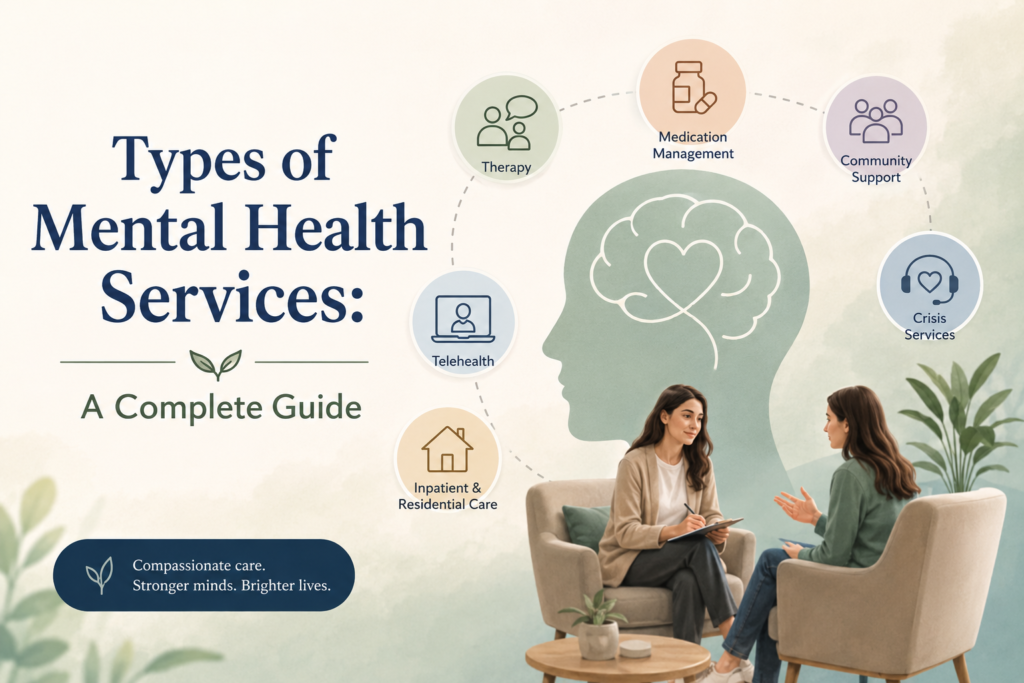
different types of mental health services including therapy, telehealth, crisis support, medication management, and inpatient care with a therapist counseling a patient.

Types of Mental Health Services: A Complete Guide

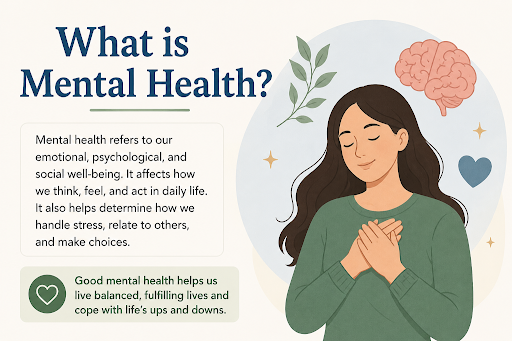
Mental health services include psychotherapy, medical management, community mental health services, hospital or residential treatment, crisis services, specialised services, and alternative therapy. These services provide essential support for your emotional and psychological well-being through their services and treatment provided by professionals who diagnose, treat, and provide medical treatment for different conditions.

Some of the common mental health conditions are depression, anxiety, and bipolar mood disorder. Each service provides different levels of care and support depending on an individual’s emotional, psychological, and behavioural health needs.

In this guide, you will get to know about different types of mental health services, things you should know to choose the right mental health services, and how you can find mental health services in Rhode Island.

The main types of mental health services at a glance

There are different types of mental health services provided by professionals such as psychiatrists, psychologists, community psychiatric nurses, social workers, and occupational therapists who work in a mental health team according to an individual’s needs.

  • Psychotherapy (Talk Therapy): This involves individual or group sessions with a professional to share behaviours, emotions, and coping skills.
  • Medication Management: It focuses on suggesting and monitoring the medical treatment of an individual.
  • Outpatient Programs: It involves providing structured, scheduled treatment to an individual at their home.
  • Inpatient and Residential Care: It offers 24/7 treatment in a hospital or specialised facility, and long-term recovery.
  • Crisis Intervention Services: It provides immediate, short-term support through hotlines, mobile teams, or urgent care in emergencies.
  • Community-Based Support: It includes support groups, case management, and rehabilitation services designed to help individuals in the local environment.

Outpatient mental health services

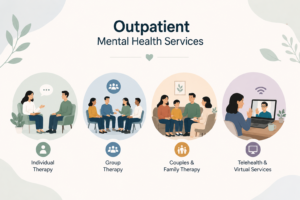
Illustration of outpatient mental health services including individual therapy, group counseling, family therapy, and telehealth support.

It is a type of mental health care that provides community-based services, which involve regular sessions with professional psychologists to focus on long-term wellness, symptom management, and personal growth without staying overnight in a hospital or facility, while you can maintain your daily routines. By providing these services, they ensure that mentally therapeutic resources are available to people at various stages of their mental health journey.

Individual therapy

Individual therapy, which is often called talk therapy, is a one-on-one process where a patient collaborates with a trained therapist regarding their personal concerns, involves diagnosing the problem and developing a care plan, and working while living at home. The session usually occurs once or twice a week for about 50 minutes. There are some common therapeutic approaches, such as cognitive behavioural therapy for changing negative thought patterns, dialectical behavioural therapy for emotion regulation, EMDR for trauma, and acceptance and commitment therapy for mindfulness. This therapy helps in managing severe stress, burnout, grief, anger, and low self-esteem.

Group therapy

This therapy involves one or more clinicians which helps in supporting a small group of individuals to share similar experiences, and everyone will get mutual support from people dealing with similar problems, and unlike individual therapy, it reduces isolation and offers interpersonal support. It is the best option for those who don’t want to feel isolated in their struggles or want to improve their interpersonal skills. It works for a wide range of psychiatric, emotional, and many other conditions, specifically depression and bipolar disorder.

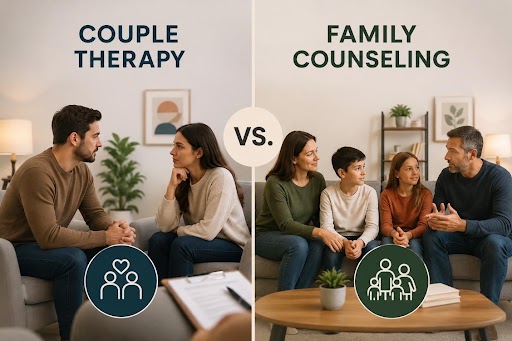
Couples and family therapy

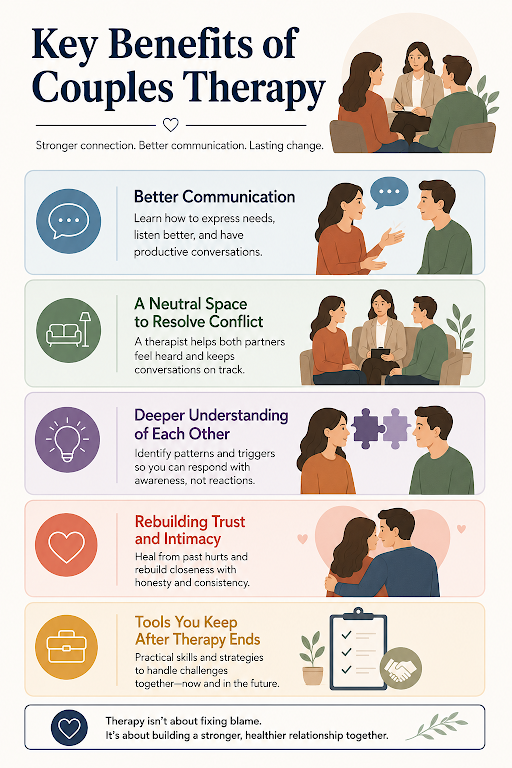
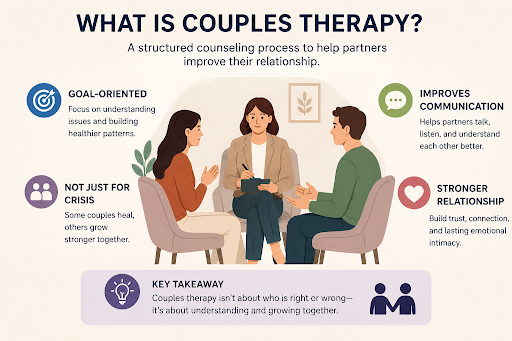
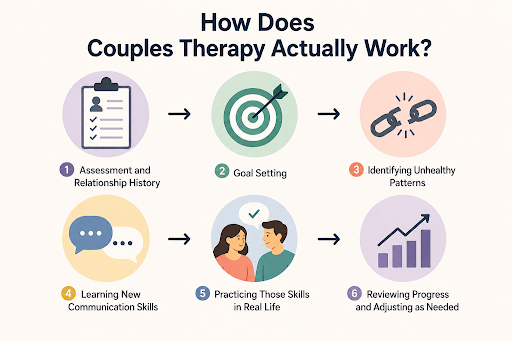
These services are designed for partners facing frequent arguments, healthy couples wanting to strengthen their bond, parents and children struggling with behavioural issues,  families having major life changes such as divorce, relocation, or a new baby, and individual support in a specific condition like depression, anxiety, or an eating disorder. While individual therapy only focuses on personal growth and self-awareness, this therapy ensures that improving communication and changes group patterns. You can expect a professional to have a neutral environment where the therapist will help to identify toxic patterns and resolve conflicts.

Telehealth and virtual mental health services

Virtual care has seen massive growth as it provides a therapy for those who don’t have access because they live in remote areas or have restrictive schedules. It is best for those individuals who want private mental health care at home in comfort or who have few symptoms of anxiety, depression, or ADHD. If you are looking for mental health services in Rhode Island, you have to ensure that the telehealth provider uses a HIPAA-compliant platform, and are licensed in your specific state, and has specialisation according to specific needs.

Why Your Doctor Treats the Disease but Not the Person Falling Apart Inside

Intensive outpatient and partial hospitalization programs

An intensive outpatient program is a high-quality treatment program for improving mental health, helping participants learn from others facing similar challenges, and supporting individuals while they can maintain daily responsibilities. This is designed for those individuals who need more than one hour of therapy per week while maintaining work or commitments. These programs typically involve 9 to 13 hours of treatment, which will last 5 to 6 weeks. The primary focus is on group therapy, individual sessions and medical management. It is best suited for drug & alcohol addiction, moderate depression, or an eating disorder that requires intensive therapy

A partial hospitalisation program is the high-intensive form of outpatient care and addiction treatment program where patients receive daily group therapy, individual psychotherapy, family therapy and medication management by a psychiatrist. It is a short-term program for 5 to 6 hours a day and five days a week, and it is often called a day treatment program in which no overnight staying is required. The level of care is designed for individuals with severe mental health disorders who are at risk of hospitalisation, and people needing an environment for recovery. 

Inpatient and residential mental health treatment

Inpatient care is the short-term and most intensive level of psychiatric service, designed for acute care within a hospital to stabilise dangerous symptoms. It takes place in a secure hospital ward where patients receive 24-hour care and nursing supervision. This is usually a short-term treatment, lasting 3 to 7 days, and the primary goal is to provide safety and immediate symptom reduction. It is best for individuals who are an immediate danger to themselves or others, or those experiencing a complete inability to care for their basic needs due to a mental health emergency.

Residential treatment is a treatment that provides a 24-hour, home-like environment for individuals with conditions like depression, bipolar disorder, and severe anxiety, and it focuses on long-term recovery and is designed for healing rather than emergency help. Residents provide a highly structured daily schedule of individual therapy, group work, and life-skills training. This treatment has a duration of 30 to 90 days, but some programs last longer. It is ideal for individuals with complex, chronic conditions such as severe PTSD, an eating disorder, or people who do not have a stable or supportive home environment to facilitate better recovery.

Community-based and crisis mental health services

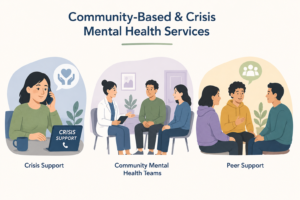
Crisis hotlines and mental health urgent care centres provide immediate, short-term support for individuals experiencing acute psychological distress. These organisations are typically run by non-profits or government agencies and staffed by trained counsellors. If someone is feeling overwhelmed, experiencing suicidal thoughts, or in the middle of a panic attack, they can use these services without a hospital visit 

Illustration showing crisis support, community mental health teams, and peer support services for mental health care.

Community mental health teams are groups including psychiatrists, nurses, and social workers who provide care to people with complex mental health needs living in the community. It is often run by the local government health department, and these teams offer counselling, medication management, and walk-in crisis services. They are ideal for individuals with chronic conditions like schizophrenia or bipolar disorder who require ongoing medical oversight to stay stable outside of a clinical facility.

Peer support involves a group of individuals who have experienced mental health challenges, providing mentorship and emotional support to others. These programs are often run by community organisations or advocacy groups like NAMI. It is best used as a supplement to professional therapy and focuses on empowering individuals and fostering social connections.  

Is It a Toxic Workplace or Am I Overreacting?

Mental health medication management

Medication management is a clinical service focused on the prescribing and monitoring of psychiatric drugs to manage symptoms. This care is provided by psychiatrists or psychiatric nurse practitioners. Unlike therapists, these providers evaluate the biological components of mental illness and provide medicine to ensure efficacy while minimising side effects. Here are some common types of psychiatric medications:

  • Antidepressants: It is used to balance neurotransmitters that affect mood and emotional response.
  • Anti-anxiety Medications: It is a fast-acting drugs that help to reduce the physical and mental symptoms of severe anxiety or panic.
  • Mood Stabilisers: It is primarily used to manage the high and lows associated with conditions like bipolar disorder.
  • Antipsychotics: It is designed to manage symptoms of psychosis, such as hallucinations or delusions, and are sometimes used to improve other treatments.

It is important to know that medication is a tool to be used alongside psychotherapy, not in place of it, because medication can stabilise a person’s biology, and therapy provides the long-term recovery to cure the problem.

How to choose the right mental health service

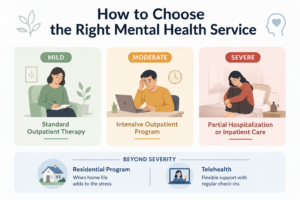
Infographic showing different mental health services based on symptom severity, including outpatient therapy, intensive outpatient programs, inpatient care, residential programs, and telehealth support.

  • Choosing the right service depends on how much your symptoms interfere with your ability to function in daily life. Here is the simple guide according to symptom severity:
  • Mild: If you are generally doing your responsibilities but feeling off, anxious, or stressed, standard outpatient therapy is the best starting point. It involves weekly sessions to build coping skills without disrupting your daily life.
  • Moderate: If you are having difficulty focusing at work, maintaining relationships, or getting through a day, an intensive outpatient program will provide a necessary boost. It involves several hours of therapy a week while sleeping in your own bed.
  • Severe: If you can’t work, care for yourself, or feel a loss of hope, a partial hospitalisation program or inpatient care is appropriate because it provides a safe, supervised environment to stabilise.
  • Beyond severity: If your home life is a main reason for you stressing, then a residential program might be better, and if you have a busy schedule but need constant check-ins, telehealth offers it in the most flexible way.


The Difference Between One-to-One Therapy, Couple Therapy, and Family Counseling


What is the 3-3-3 rule in mental health?

The 333 rule is an informal coping technique that can effectively manage anxiety when it feels particularly overwhelming. It involves observing 3 things you see, 3 sounds you hear, and moving 3 body parts. You can use it to redirect attention away from physical symptoms, to interrupt overthinking while in a crowded or stressful environment or before a big presentation or a difficult conversation, to regain emotional control.

Finding mental health services in Rhode Island

finding the right mental health services in the ocean state requires a practical approach. To find local providers, start with the Rhode Island Department of Behavioral Healthcare (BHDDH) database or use reputable insurance directories. When you are choosing between providers, you should consider your needs such as private practice offers specialized, consistent care with shorter wait times but may have higher cost and Community Care is best for comprehensive support, though it has high demand which can impact scheduling.

Choosing the right mental health service is a deeply personal decision that should reflect your unique history, current symptoms, and long-term goals. What works for one person may change as their needs evolve over time. If you’re feeling unsure of where to begin, reaching out for a professional evaluation can help clarify which level of care is best for you. Finding a practice that aligns with your values is the first step toward sustainable wellness.

Frequently Asked Questions

Do you accept my specific Rhode Island insurance plan?

Coverage for therapy services can vary depending on your insurance provider and plan. If you’re looking for individual therapy in Rhode Island or family counseling services, we recommend contacting us directly so we can help verify your benefits and explain available options. We’re happy to guide you through the process and answer questions about coverage for in-person or family therapy online sessions.

Are you currently taking new patients for my specific concern?

Yes, we welcome new clients for a range of concerns, including anxiety, depression, relationship stress, Family of origin issues, grief, life transitions, and therapy for family conflicts. We also provide support for concerns related to self-confidence, Career counseling, caregiving stress, and emotional overwhelm. Availability may vary depending on the type of support you’re seeking, but we’ll do our best to match you with the right therapist and appointment schedule.

What is your typical wait time for an initial intake appointment?

Initial appointments are usually available within a few days to two weeks, depending on scheduling and the type of service requested. We understand that reaching out for support can already feel difficult, so we aim to make the process as smooth and timely as possible. Whether you’re seeking individual therapy online, one-to-one therapy, or working with a counselor for family problems, we’ll help you get started with clarity and support.

Do you offer telehealth options for follow-up sessions?

Yes. We offer secure and convenient telehealth options for both new and existing clients. Individual therapy online, online couples counseling, and family therapy online sessions are available for clients who prefer the comfort and flexibility of attending therapy from home. Online sessions are designed to provide the same level of care, structure, and confidentiality as in-person appointments.

Read More
Family therapy session with parents and child talking to a counsellor about communication, emotional support, and healthy family relationships.

What Is Family Therapy, And How Can It Help Your Family?

Family therapy which is also known as family counselling, is a type of psychotherapy designed to improve communication, resolve conflicts, and strengthen relationships among family members by viewing problems within the context of the entire unit. Its core purpose lies in treating mental health issues, reducing family tension, and developing a supportive environment.

This guide will cover what family counselling is, family counselling services, key benefits, and ultimately how it can help your family according to their respective needs.

What is family counselling?

Family counselling session with therapist helping parents and child improve communication and relationships

Family counselling aims to address psychological, behavioural, and emotional issues that cause family problems. Family members will work with a therapist or counsellor to develop and maintain a healthy relationship.

Family system theory is a scientific theory of human behaviour that views the family as an interconnected and interdependent system. Each member’s behaviour and interactions are seen as influencing the entire family unit. It emphasises the importance of relationships and interactions among family members. It asserts that issues within a family cannot be understood in isolation but rather as part of the larger system.

People often use family counselling and therapy interchangeably, but there are subtle differences in both:

Counselling tends to be more focused on one specific issue and is considered as a short-term treatment. You may learn coping techniques and “problem-solve” issues together. On the other hand, therapy tends to treat a broader range of issues and more complex problems. It can be a long-term treatment.

What is the primary goal of family therapy?

The main goal of family therapy is to improve the family’s ability to function, establish healthy boundaries, and teach the family how to solve future problems without the therapist’s help.

Types of Mental Health Services: A Complete Guide

The Core Benefits Of Family Counselling 

Family counselling helps families to improve their communication, resolve conflicts, and build stronger relationships.

Although it also has a wider coverage in terms of its worth, some of them are listed below:

  1. Improve communication: Any type of therapy includes communication, so family therapy guides you to be more open and provides a platform where you can feel more comfortable and discuss your feelings in a neutral environment free from judgement.
  2. Resolving conflict: Family counselling is a good tool to explore conflict among family members and potentially resolve them, as in any stance, where one family member does not get along with other conflicts will arise.
  3. Coping skills: Family therapy also emphasises coping skills, as it includes techniques like problem-solving and psychoeducation about stress, which help families to develop resilience.
  4. Setting boundaries: If in your family, you feel uncomfortable because everyone is entitled to your time and attention, and you can’t even say no for the other person’s sake. Family counselling will help you set clear, healthy boundaries based on your feelings, needs and wants.
  5. Strengthen relationships: The general cause of families going to therapy is that their bond is not strong enough, or that they feel emotionally distant from each other. Family counselling helps those families to revitalise their bond so that they can feel close to each other.
  6. Addressing any grief or loss: Family counselling helps families suffering from any psychological shock or loss, as many changes like divorce, death, unemployment, or bankruptcy can trigger problems in families.

How does family counselling help with communication?

Family counselling session helping parents and teenager improve communication and emotional understanding

Communication is the primary reason families seek therapy. Family therapy creates a place where people can talk about things without being afraid. A therapist helps the family talk to each other in ways. This means family members can understand each other and get along better. Family therapy makes family relationships stronger.

Imagine a teenager who starts spending most of their time alone in their room. The parents may see this as rude or distant behaviour, which often leads to arguments and more emotional distance. In family counselling, each person is encouraged to express what they truly feel instead of reacting to the behaviour alone.

A parent might share feeling worried or disconnected, while the teen may explain feeling stressed and emotionally drained. Once both sides understand the emotions behind the actions, the family can work on small compromises that create both personal space and stronger connection.

Is It Love or Obligation?

When does a family need counselling?

In many instances, a family can need therapy, but sometimes the family members are so habitual of living in that problematic environment that they can’t even sense the need for therapy. A counsellor for family therapy can help in this scenario.

Major transitions like divorce or separation are among the most common catalysts. During these times, a family divorce therapist acts as a neutral guide to help parents and children navigate the shifting landscape of their home life without getting lost in the resentment.

Similarly, the weight of grief and loss can cause family members to retreat into their own shells. Counselling helps bring everyone back together to process the pain collectively, ensuring that no one has to mourn in isolation.

Behavioural issues in children or teens such as sudden academic failure, aggression, or social withdrawal are often symptoms of a larger family dynamic that needs adjustment.

 When addiction or chronic illness enters the picture, the family often develops survival roles that can become toxic over time. A counsellor helps the family address the illness or substance use while also healing the secondary trauma it has caused the rest of the group.

“Family therapy examples”

To see how family therapy works in life, let’s look at some simple examples.

A family that recently moved to a city may see one child become quiet and another act out. This is where therapy comes in. It helps them talk about their feelings of loss and not being in control. Family therapy is really helpful here.

Counseling for families helps parents and kids adjust to new roles and rules. It also helps them deal with the emotions that come with these changes. Counselling supports both parents and children during this time.

When a parent gets a challenge, family therapy sessions give everyone a safe space to share their feelings. They can talk about their fears, stress and emotional struggles. The goal is to learn how to support each other through this time.

Types of family therapy

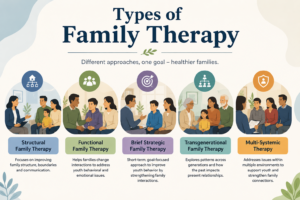
Illustration showing different types of family therapy including structural, functional, strategic, transgenerational, and multi-systemic therapy approaches.

When exploring the different types of family therapy, it is important to understand that each approach offers a unique lens for viewing family dynamics and behavioural health.

Structural family therapy enhances family dynamics by clarifying boundaries and improving communication. This approach aims to resolve conflicts and address mental health issues by transforming family interactions. Techniques like family mapping and role-play are used to uncover and change dysfunctional patterns.

Functional Family Therapy is an evidence-based treatment model that helps families change their interactions to address behavioural or emotional issues in youth and young adults. FFT views family dynamics through a relational lens, acknowledging that families develop unique interaction patterns and meanings.

Brief Strategic Family Therapy is a short-term structural family systems framework to improve a youth’s behaviour problems by improving family interactions. The target population in general is children and adolescents between 8 and 17 years of age displaying or at risk for developing behaviour problems, including substance abuse

Transgenerational or intergenerational family therapies typically attend to dynamics across more than two generations. Transgenerational therapies are more interested in how the past affects the present. These therapies are not interested in learning about individual pathology. Rather, they are interested in how families, across generations, develop patterns of behaving and responding to stress in ways that prevent healthy development in their members and lead to predictable problems. 

Multi-Systemic Therapy is a family therapy programme which works with children aged 10-17 and their families when the children are at risk of being placed in custody or care. It aims to promote positive family relationships, support the child to engage in education and training, tackle problems like substance use, and protect the child against involvement in crime and violence.

The Difference Between One-to-One Therapy, Couple Therapy, and Family Counseling – And How to Pick the Right One

The Five Core Principles Of Family Therapy

The five core principles of family therapy are:

Systems Thinking

In this principle, the family is viewed as a system where every member’s behaviour is interdependent. A change in one part affects the whole system.

Focus on Interactional Dynamics

In this principle, therapy concentrates on exploring and restructuring dysfunctional, repetitive interaction patterns between members rather than exploring individual pathology.

Circular Causality

This principle asserts that rather than blaming one person for causing a problem, one should focus on how family members act in feedback loops where behaviours reinforce each other.

Empowerment & Strength Mobilisation

In this principle, therapists identify and mobilise the family’s internal strengths and functional resources to solve problems, rather than acting as a top-down expert.

Structural Change and Boundary Setting

This principle’s therapy aims to clarify boundaries between subsystems (parents, children, extended family) to create a more functional, balanced, and stable family structure.

Family Counsellor Online: What To Expect?

In-person therapy includes therapist-facilitated conversations that go through your emotional and mental health, any difficulties or issues you’re experiencing, and your development and progress. Therapists typically schedule individual sessions once a week for 40 or 60-minute time blocks.

During online therapy sessions, you meet with your therapist remotely. These therapies are also referred to as telepsychology or teletherapy; these online sessions mimic in-person therapy, except you won’t travel to your therapist’s office. Counselling online adheres to the same scheduling formats as traditional therapy. You regularly attend appointments that last about 40-60 minutes.

“Family therapy website”

When searching for family therapy online, look for platforms that prioritise HIPAA-compliant video software to ensure your family’s privacy is protected. Most reputable sites will offer a brief meet and greet or consultation to ensure the counsellor’s style matches your family’s personality.

How To Find The Right Family Counselling Services?

These are the steps to look over to find the right family counselling services:

Step 1: The first and main step in finding the right family counselling services is identifying your family’s specific needs and goals. Acknowledge to yourself why you are seeking therapy so that you will search for a specialist rather than a generalist.

Step 2: After acknowledging your need, research qualified professionals with specific training in family systems. Ensure they are a Licensed Marriage and Family Therapist (LMFT), Licensed Clinical Social Worker (LCSW), or licensed psychologist.

Step 3: Consequently, evaluate the therapist’s approaches and style. Different therapists use different techniques, such as Structural, Strategic, Systemic, or Cognitive-Behavioral family therapy. Match their method to the issue. If you need help with practical, behaviour-based solutions, look for structural or strategic therapy.

Step 4: Before starting the therapy, schedule initial consultations with the therapist. Most therapists offer a brief initial consultation or phone call. Use this “test run” to assess compatibility and ask these Key Questions: What is your experience with issues like ours? How do you involve children in the process? What is your approach to handling secrets or separate, individual conversations? 

Step 5: After finding a potential match, review practical logistics to ensure consistent attendance. Check if they accept your insurance or offer a sliding-scale fee for out-of-pocket payments, and confirm they have hours that fit your family’s schedule, as many therapists only run family counselling center and do not do therapy virtually.

Is Family Therapy Effective? What the Research Says

Decades of clinical research confirm that family therapy is a highly effective gold standard for treating mental health and relationship issues. Unlike individual therapy, which focuses on the person in isolation, family-based interventions address the environment, which often leads to more permanent change.

For Children & Adolescents: Research consistently shows that family therapy is superior to talk therapy alone for treating behavioural problems, eating disorders, and depression in youth.

For Couples: Studies indicate that roughly 70% to 75% of couples who engage in therapy see a significant improvement in their relationship satisfaction. Even more promising, these benefits tend to last long-term because the couple learns a new shorthand for resolving future conflicts.

For Substance Abuse: When a family is involved in a loved one’s recovery, the success rates for maintaining sobriety increase dramatically. The family learns to stop enabling behaviours and starts providing the specific type of accountability that drives recovery.

Conclusion

Building a stronger, more resilient family doesn’t mean you have to have all the answers; it just means you’re willing to ask the right questions together. Whether you are navigating a major life transition, healing from past trauma, or simply looking to break old patterns of communication, professional support provides the roadmap to a more peaceful home.

You don’t have to navigate these complexities in isolation. If you’re ready to take the first step toward a healthier family dynamic, explore our specialised family counselling services or book a consultation today to find the right fit for your unique needs.

Frequently Asked Questions


Q1. What is the primary goal of family therapy?

The primary goal is to improve the family’s overall “health” by enhancing communication, resolving deep-seated conflicts, and creating a supportive home environment. It aims to give families the tools to solve future problems independently without needing a therapist’s intervention.

Q2. What are the five core principles of family therapy?

The five principles include: 1) Systems Thinking (the family is a unit), 2) Circular Causality (actions are chain reactions), 3) Neutrality (the therapist doesn’t take sides), 4) Homeostasis (identifying patterns that resist change), and 5) Self-Correction (empowering the family to adjust their own behaviours).

Q3. Why would family therapy be avoided (Red Flags)?

Family therapy should be avoided in cases of active domestic violence where a member’s safety is at risk, or if one member is being forced to attend against their will. It is also ineffective if one member has an untreated severe mental health crisis that prevents safe participation.

Q4. How does family therapy differ from individual therapy?

While individual therapy focuses on a person’s internal thoughts and history, family therapy focuses on the relationships and patterns between people. In family therapy, the “patient” is the relationship itself, rather than any one specific individual.

Read More

Why Your Doctor Treats the Disease but Not the Person Falling Apart Inside

You went to the appointment. You sat in the chair, answered the questions, got the prescription. Maybe you walked out with a diagnosis or a referral or just a follow-up date circled on a card.

And then you sat in your car and felt, quietly, that something important had not been said.

Not by you. Not by them. Just not said.

That feeling has a reason. And it’s not in your head.

The Gap Nobody Talks About

Medicine is very good at finding what’s wrong with your body. It has names for things, numbers for things, treatments for things. Your blood pressure, your glucose levels, your inflammation markers. It can tell you, with impressive precision, what is happening inside your cells.

What it struggles with, consistently, is the person attached to those cells.

The American Heart Association put it plainly in a scientific statement: clinicians are very good at treating disease but often not as good at treating the person, with the focus of attention being on the specific physical condition rather than the patient as a whole.

That’s not an accusation. Doctors are trained within a system that rewards diagnostic precision and moves fast. A typical primary care appointment runs twelve to fifteen minutes. In that window, a doctor is managing your chart, your history, your current complaint, your medications. There isn’t space in that structure to ask: how are you holding up, really? And even when they do ask, most patients don’t know how to answer. They say fine. They say managing. They say the thing they came in about. So the physical gets treated. And the rest waits.


What Waits Is Not Harmless

Here’s where it gets important. The assumption most people carry into a doctor’s office is that the body and the mind are separate concerns, to be handled by separate people in separate appointments. The body breaks, the doctor fixes it. The mind struggles, and that’s a different queue entirely.

Research has been dismantling that assumption for decades.

Among patients living with chronic diseases, the prevalence of stress, anxiety, and depression was found to be 68.7%, 51.1%, and 58.8% respectively. More than half the people sitting in waiting rooms with a physical diagnosis are also carrying significant psychological weight. And that weight is not sitting quietly to one side. It is actively changing the course of the illness.

People with diabetes, for example, are two to three times more likely to develop depression than people without diabetes. Yet only 25 to 50% of diabetics with depression are ever diagnosed and treated for it.

Chronic stress has been linked to a state of chronic low-grade inflammation, which has in turn been associated with the development of cardiovascular disease, diabetes, cancer, autoimmune conditions, and mental illnesses including anxiety and depression.

In other words: the stress doesn’t just sit in your chest. It gets into your biology. It changes how your immune system responds, how your body heals, how effectively you can manage the very condition your doctor is treating. Depression in people with diabetes leads to poorer blood sugar control, decreased physical activity, higher rates of obesity, and greater risk of long-term complications. Your emotions are not a side issue. They are part of the illness.

Why Stress Management Is Not a Luxury Recommendation

Woman practicing stress management through mindfulness therapy with a doctor in a calm clinical setting


“Reduce stress” is one of those things doctors say near the end of an appointment, in the same breath as “drink more water” and “get enough sleep.” It sounds like advice you could follow if you just decided to. As if the problem is that you hadn’t thought of it.

Real stress management is not a lifestyle tip. It is clinical work. Evidence shows that mind-body interventions, including cognitive behavioral therapy, mindfulness-based approaches, and relaxation techniques, significantly improve immune function by reducing stress markers, lowering cortisol levels, and decreasing pro-inflammatory responses in the body.

That’s not soft language. That’s measurable, biological change.

The challenge is that genuine stress management requires understanding where your stress is actually coming from. And that’s rarely the surface answer. It’s rarely just the job, or the diagnosis, or the difficult year. Often it runs deeper than that. Often, it connects to patterns that have been in place for a long time, ways of responding to pressure and pain that you developed long before you were old enough to choose them.

Your doctor cannot get there in twelve minutes. They aren’t trained to. That’s not a failure of medicine. It’s just the boundary of what medicine was designed to do.


Is It Love or Obligation?

The Part That Started Before You Got Sick

There’s a layer to this that most people never get to examine, because nobody ever creates the space for it.

A lot of what shows up in the body in midlife, in a diagnosis, in a season of persistent stress, has roots that go further back than the thing that seems to have triggered it. The way you handle conflict. The way you respond to being vulnerable. The things you will not ask for, no matter how badly you need them. Whether you tend to internalize, or shut down, or keep going until you can’t.

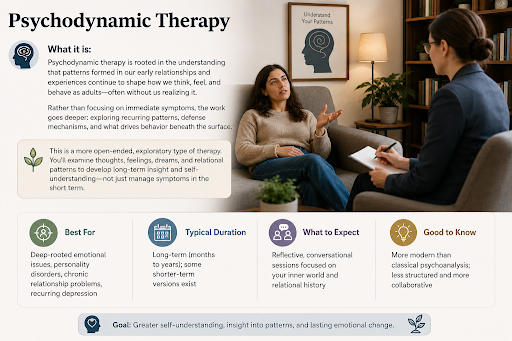
These patterns often trace back to what therapists call family of origin issues, the dynamics, roles, and emotional blueprints that were established in the family you grew up in, long before you had any say in the matter. They don’t disappear when you grow up. They follow you into your relationships, your work, your body.

A doctor cannot see this. A prescription cannot touch it. But it shapes how you experience illness, how you cope with it, how much of your energy goes toward managing fear versus healing.

Therapy for Anxiety Is Not Just About Anxiety

therapy for anxiety is not just about anxiety


When people think about therapy for anxiety, they tend to picture someone who is visibly falling apart. Panic attacks. Can’t leave the house. Something dramatic and obvious.

But anxiety in people with chronic illness is often quieter than that, and more corrosive. It’s the 3am spiral about what the next test will show. The way you brace yourself before every appointment. The exhaustion of performing fine for everyone around you while carrying something you haven’t named. The low-level dread that has become so familiar you’ve stopped recognizing it as dread.

Therapy for anxiety in this context is not about eliminating fear. Fear, in the face of illness, makes complete sense. What therapy does is change your relationship to it. It helps you stop being ambushed by it. It gives you the ability to be in the middle of something hard without that hardness consuming everything else.

Patients with chronic illness often attach greater importance to their mental health than their doctors do, while doctors focus predominantly on physical limitations. That gap, between what patients know they need and what they are actually offered, is exactly where therapy for anxiety lives and works.


Is It a Toxic Workplace or Am I Overreacting?

What Happens When You Finally Get Both

There is a version of care that holds both the physical and the emotional at once. It’s not complicated in theory. It’s just rare in practice.

When someone living with a chronic condition works with a therapist alongside their medical care, the effects show up in both places. Managing depression and emotional distress in people with chronic illness has been shown to improve physical outcomes, including blood sugar control in diabetics and engagement with self-care routines. Stress management, done seriously in a therapeutic context rather than as a self-help afterthought, changes how the body responds to illness.

More than that, it changes how the person inside the body responds to their life.

Because the goal was never just to survive the diagnosis. It was to not lose yourself in the process of managing it.

You Deserve More Than a Prescription

Your doctor is not failing you by focusing on the disease. They are doing the job the system was built to do.

But that job has a boundary. And on the other side of that boundary is the part of you that is exhausted, scared, holding things together for everyone around you, and wondering privately if this is just what life feels like now.

It doesn’t have to be.

The work of understanding what your stress is actually about, where your anxiety lives and why, what your body has been holding that your chart never captured, that work is available to you. It’s not a luxury. It’s not something to get to once things settle down. It is, in many ways, the thing that makes settling down possible.

You were never just a diagnosis. You don’t have to keep living like one.

Dr. Noreen Shaffi offers therapy for anxiety, stress management, and chronic illness support through her practice in Pawtucket, Rhode Island, and online across Massachusetts and Texas. If something in this resonated, a first session is a good place to start.

Read More

The Difference Between One-to-One Therapy, Couple Therapy, and Family Counseling – And How to Pick the Right One

You didn’t open this at a good time of day.

You opened it because something is off, and has been off for a while, and tonight it got loud enough that you ended up here, reading about therapy, trying to figure out if what you’re feeling is bad enough to do something about.

It is. You don’t need to wait until it gets worse.

But here’s the thing nobody tells you when you first start looking: there’s more than one kind of help. And the difference matters, not because one is better than another, but because the right kind of support depends entirely on where the pain is actually coming from.

So let’s talk about that. Plainly. Without the clinical language.

When it’s mostly yours to carry

Some pain is personal. It lives inside you, not between you and anyone else. You wake up with it. You carry it through your day. You put it down at night and it’s there again in the morning.

Maybe it’s anxiety that doesn’t have a clear reason. Maybe it’s a version of yourself you’ve been at war with for years. Maybe something happened, recently or a long time ago, and you’ve been managing it so well on the outside that nobody around you even knows.

That’s when One to One therapy is what you need.

Not because your relationships don’t matter. But because some things need to be looked at alone first, in a room where you’re not performing for anyone, not softening anything for anyone’s comfort, not watching someone’s face to see how they’re taking it.

One to One therapy gives you something most people have never actually had: a space that is entirely, uncomplicatedly yours.

The research backs this up. About 75% of people who enter individual psychotherapy show measurable benefit, improvement in symptoms, in functioning, in how they move through their lives. But numbers aside, what most people say afterward is simpler than that. They say: I finally understood why I kept doing that.

That’s what One to One therapy is actually for.

When it’s living between you and your partner

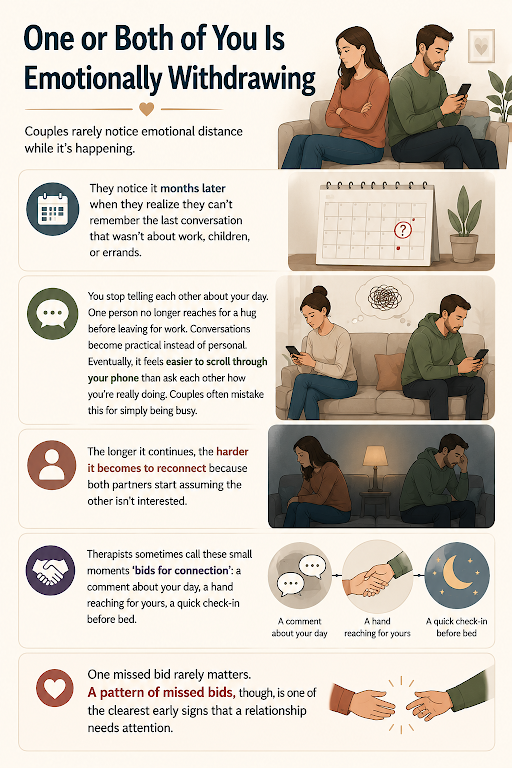
Couple sitting apart during therapy session representing emotional distance and relationship healing through couples counseling.

This kind of pain is harder to locate. Because it’s not exactly yours and it’s not exactly theirs. It sits in the silence after an argument. In the way you’ve stopped bringing certain things up. In the feeling that you’re both trying, and somehow it’s still not working.

You love each other. That’s not the question. The question is why the same wound keeps opening.

Couple therapy isn’t about deciding who’s right. A good therapist isn’t a referee. What they’re doing, if they’re doing it well, is helping you both see the pattern that neither of you can see from inside it. Because when you’re in it, you can only see your side. That’s not a flaw. That’s just how it works.

Why Your Doctor Treats the Disease but Not the Person Falling Apart Inside

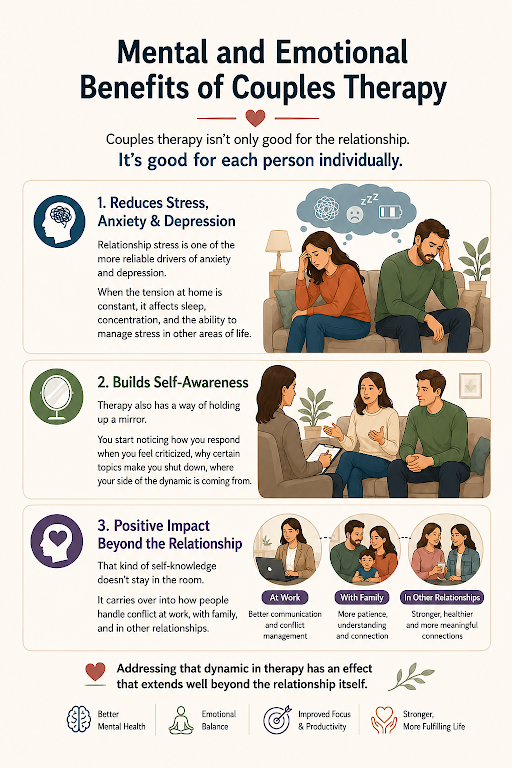
Research shows that nearly 90% of people who go through couples counseling report improvement in their emotional wellbeing, and over 75% report greater satisfaction in the relationship. And here’s the part that surprises most people: couple therapy tends to produce better outcomes than no treatment even in cases where the relationship ultimately ends. Because the goal was never just to keep two people together. It was to help two people understand each other, and themselves, more clearly.

If getting to a therapist’s office feels impossible, the schedules, the logistics, the vulnerability of sitting in a waiting room together, couple therapy online is a real and equally effective option. A 2024 study following 490 participants found no meaningful difference in outcomes between online and in-person couples therapy. Some couples find it easier, actually. There’s something about being in your own space that lowers the guard just enough.

If you’ve been thinking we should probably talk to someone and then not doing it, this is the part where you do it.

When the whole house is hurting

Sometimes it’s not one person’s pain and it’s not two people’s pain. It belongs to everyone, and everyone is feeling it in a different way, which makes it harder, not easier, to fix.

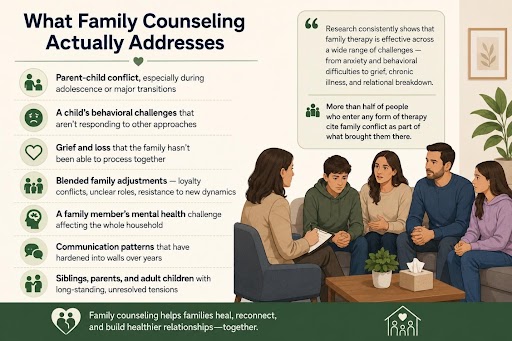
A child who’s started acting out. A family that’s been through something, a loss, a move, a diagnosis, and hasn’t come back together on the other side of it. Parents and adult children with years of unsaid things between them. A home where people love each other and can’t seem to stop hurting each other.

Family counseling services exist for exactly this.

The premise is simple, even if the work isn’t: no one person’s behavior happens in isolation. The way a family communicates, what’s allowed to be said, what gets buried, who carries what, creates a system. And when that system is under enough stress, it shows up in everyone. Sometimes it shows up most visibly in the person least equipped to hide it.

Research consistently shows that family therapy is effective across a wide range of challenges, from anxiety and behavioral difficulties to grief, chronic illness, and relationship breakdown within the family unit. And more than half of people who enter any form of therapy cite family conflict as part of what brought them there, which means even when someone comes in saying I have a problem, the roots are often relational.

Family counseling services don’t work by identifying the person who broke things. They work by helping an entire family find a new way to be with each other. That’s slower, messier, and more worthwhile than most people expect.

How to know which one is for you

You don’t need to have this figured out before you call someone. That’s the therapist’s job too, to help you understand what kind of help fits what you’re actually carrying.

But if you’re sitting here tonight trying to make sense of it:

If the pain feels internal, like it’s about you, your history, your mind, your patterns, start with One to One therapy.

If the pain feels relational, like it’s about what’s broken or stuck between you and your partner, couple therapy is where the work is. And if in-person feels like too much right now, couple therapy online is just as real.

If the pain has spread across the whole family, if it’s in the air at home, if everyone is feeling it even if nobody’s talking about it, family counseling services are built for that.

And if you’re still not sure? Say that. A good therapist won’t make you feel foolish for not knowing. They’ll help you find out.

You came here tonight looking for something. Maybe clarity. Maybe permission. Maybe just the feeling that someone else has seen this before and knows what to do with it.

They have. And they do.

You don’t have to have the right words when you reach out. You just have to reach out.

Dr. Noreen Shaffi offers One to One therapy, couple therapy online, and family counseling services in Pawtucket, Rhode Island, and online across Massachusetts and Texas. If tonight felt like the night to do something about it, book a session.

Read More

Is It Love or Obligation?

Understanding Guilt in Family Relationships

Why this question feels uncomfortable to even ask

Most people don’t sit down and clearly think, “I feel obligated to my family.”

What they feel is something more tangled.

They feel guilty for not calling enough.
Guilty for wanting space.
Guilty for feeling irritated when they “should” feel grateful.

And underneath all of that is a quieter, more uncomfortable thought:

If I love them, why does this feel like pressure?

That’s where the confusion begins. Because in many families, love and obligation are so closely tied together that separating them can feel almost disloyal.

When love starts to feel heavy

Healthy love has a certain quality to it. It allows closeness, but it also allows space. It doesn’t require you to constantly prove your care through sacrifice.

Obligation feels different.

It shows up as a sense that you should do something, even when you’re emotionally exhausted. It makes relationships feel like responsibilities you have to manage rather than connections you can return to.

The tricky part is that obligation often disguises itself as love.

You tell yourself, “I’m doing this because I care.”
But if you pause and look closely, the emotion underneath might not be warmth. It might be anxiety, guilt, or fear of disappointing someone.

That doesn’t mean there’s no love. It just means something else has become attached to it.

A simple way to tell the difference

Instead of trying to analyze the relationship as a whole, it helps to look at your internal response in specific moments.

Think about the last time your family asked something of you.

Did it feel like a choice you were willing to make, even if it required effort? Or did it feel like something you couldn’t really say no to, even if you wanted to?

Love usually allows for choice. Even when you say yes, it feels like your decision.

Obligation removes that sense of choice. You may still say yes, but it feels like you had no real alternative.

That distinction matters more than the action itself.

Where the guilt comes from

Guilt in family relationships doesn’t come out of nowhere. It’s usually learned, slowly and subtly.

In many families, approval is tied to compliance. Being “good” means being accommodating, respectful, and available. Over time, this creates an internal rule:

If I don’t meet expectations, I’m letting someone down.

That rule doesn’t disappear when you grow up. It just becomes quieter and more internal.

So even when no one is directly asking anything unreasonable, you still feel responsible. You anticipate reactions. You manage emotions that may not even be expressed.

This is why guilt can show up even in relatively calm families. It’s not always about what is happening now. It’s about what you’ve learned to expect.

How this plays out in everyday situations

This dynamic shows up in ways people often overlook.

You agree to plans even when you need rest, and then feel resentful afterward. You avoid difficult conversations because you don’t want to upset anyone. You find yourself explaining or justifying decisions that don’t actually require approval.

Over time, this creates a pattern where your needs become secondary, not because they don’t matter, but because they feel harder to prioritize.

In relationships, this can also spill over. Many couples struggle not just with each other, but with the expectations that come from their families. It’s not uncommon for people to seek online couples counseling when the tension isn’t only between partners, but between the relationship and the family system around it.

Why “just set boundaries” doesn’t always work

Advice around boundaries is everywhere, and while it’s useful, it often misses something important.

Setting a boundary with a stranger is very different from setting one with family.

With family, you’re not just dealing with the present moment. You’re dealing with history, roles, expectations, and emotional patterns that have developed over years.

So when someone tries to set a boundary, the difficulty isn’t just in saying the words. It’s in managing what follows.

The guilt.
The second-guessing.
The fear that you’ve damaged the relationship.

This is why many people understand boundaries intellectually, but struggle to apply them consistently.

A more realistic way to approach it

Instead of trying to eliminate guilt completely, it can be more helpful to change how you respond to it.

Feeling guilty doesn’t automatically mean you’ve done something wrong. Sometimes it simply means you’re doing something differently than you’re used to.

Start by noticing when guilt shows up, and ask a different question:

Is this guilt coming from harming someone, or from not meeting an expectation?

Those are not the same thing.

If your actions are respectful but still uncomfortable for others, that discomfort does not automatically mean you’ve made the wrong choice.

When it starts affecting your well-being

There’s a point where this pattern moves beyond occasional discomfort and starts affecting your mental health.

You may feel constantly responsible for how others feel. You may struggle to relax because you’re always anticipating what’s expected of you next. You may feel emotionally drained after interactions that are supposed to feel supportive.

This is often when people begin exploring therapy for family conflicts, not because they don’t care about their family, but because they care enough to want a healthier way of relating.

In many cases, family therapy online can help unpack these patterns in a structured way, especially when direct conversations feel difficult or overwhelming.

What changes when you separate love from obligation

One of the most important shifts is this:

You stop measuring love by how much you sacrifice.

Instead, you begin to measure it by how honest and sustainable the relationship feels.

When obligation is reduced, something interesting happens. The resentment starts to fade. The interactions that remain begin to feel more genuine, not because you’re doing more, but because what you’re doing feels chosen.

This doesn’t mean relationships become perfect or conflict-free. It means they become more balanced.

A question worth sitting with

If you’re unsure where you stand, consider this:

If guilt wasn’t part of the equation, what would change about how you show up in this relationship?

That question can be uncomfortable, but it’s also clarifying.

Because the goal isn’t to love less. It’s to relate in a way that doesn’t require you to constantly override yourself.

What to take with you

You don’t have to reject your family to question certain patterns within it. You don’t have to choose between caring about others and caring about yourself.

Sometimes, the work is simply noticing where love ends and obligation begins.

And once you can see that clearly, you have more choice in how you respond.

If you find yourself stuck in that space, where every choice feels loaded with guilt, talking to someone outside the dynamic can help you see it more clearly. Whether through therapy for family conflicts or structured support like online couples counseling, the goal isn’t to distance you from your relationships, but to help you experience them with less pressure and more clarity.

Because love, at its healthiest, doesn’t feel like something you’re constantly trying to get right. It feels like something you can actually live inside.


Read More

Service Areas

We proudly serve multiple locations across Massachusetts and Texas.

📍 Quincy, Massachusetts
📍 Waltham, Massachusetts
📍 Newton Upper Falls, Massachusetts
📍 Lexington, Massachusetts
📍 Malden, Massachusetts
📍 Cambridge (Kendall Square), Massachusetts
📍 Hopkinton, Massachusetts
📍 Plano, Texas
📍 Frisco, Texas
📍 McKinney, Texas
📍 Garland, Texas
📍 Dallas (Oak Lawn), Texas
📍 Rockwall, Texas
📍 Little Elm, Texas
📍 Irving, Texas
📍 Houston, Texas
📍 Sugar Land, Texas
📍 Richmond, Texas
📍 Dallas, Texas