

Couples rarely wake up one morning and decide their relationship is in trouble. More often, the changes are gradual. Conversations become shorter.
Small disagreements turn into familiar arguments. Time together starts feeling more like managing responsibilities than enjoying each other’s company.
These patterns don’t automatically mean a relationship is failing, but they can signal that something important isn’t being addressed. Knowing when to seek couples therapy isn’t about waiting for a crisis.
It’s about recognizing the signs early enough to change the pattern before the frustration and resentment become harder to resolve.
If you’re wondering about the signs that indicate when you need couples therapy, these are some of the clearest indicators:
- The same arguments keep happening without resolution
- Communication has broken down
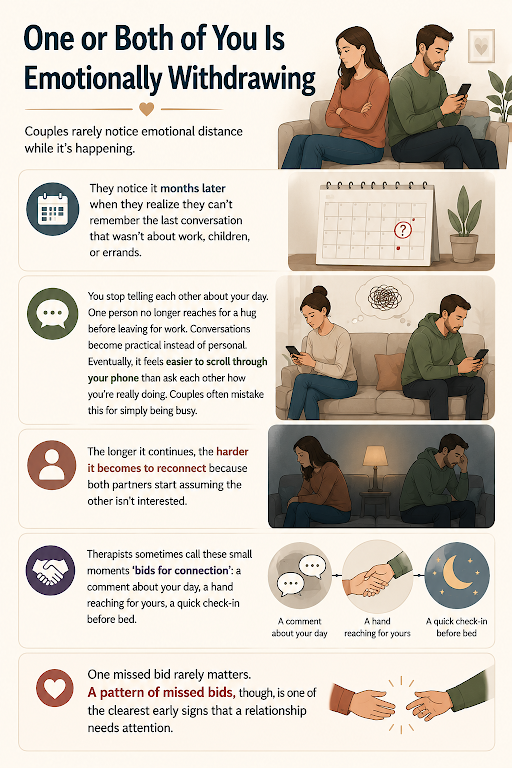
- One or both of you is emotionally withdrawing
- Trust has been broken
- Physical or emotional intimacy has faded
- A major life change is straining the relationship
- You feel more like roommates than partners
- Infidelity has occurred
- You disagree on parenting
- Financial conflict keeps escalating
- One partner’s mental health is affecting the relationship
- You’re considering separation
- You want a stronger relationship, not just a repaired one
Some patterns are obvious. Others become part of daily life so gradually that couples stop noticing them until the relationship feels very different.
Read More Blog: Why Your Doctor Treats
1. The Same Arguments Keep Happening Without Resolution
You already know how the conversation is going to end.
One of you brings up the dishes, spending, or weekend plans. Within a few minutes, the discussion has shifted to something that happened months ago.
Eventually, someone walks away frustrated, and nothing actually changes. A week later, you’re having the same argument again.
When conflict becomes repetitive, the issue is often bigger than the topic itself. The disagreement may really be about feeling unheard, carrying unequal responsibilities, or believing your concerns never matter. The original problem stays hidden, so the argument keeps finding a new way to surface.
Therapists sometimes describe this as the difference between the content of an argument and the process behind it.
Couples keep revisiting the content- the dishes, the money, the schedule- while the process, how they fight and who shuts down first, never gets addressed. Once that pattern is visible, the same disagreement stops repeating in the same way.
Once couples recognize what they’re actually arguing about, the conversation usually becomes less about winning and more about solving the real problem. A therapist helps uncover those hidden patterns when they’re difficult to see on your own.
2. Communication Has Broken Down
The conversation ends before it really begins. One of you says, “Forget it.” The other walks away, assuming that the problem is over.
Sometimes they look like short answers, uncomfortable silence, or changing the subject whenever something important comes up.
One partner may stop bringing up concerns because previous conversations felt pointless. The other may assume everything is fine simply because arguments have become less frequent.
Over time, important conversations are replaced by discussions about schedules, bills, or household responsibilities.
The relationship keeps functioning, but meaningful connection starts to disappear. If you’ve been asking yourself when you need couples therapy, this kind of communication breakdown is a strong sign.
Left alone, this pattern usually becomes harder to reverse because both partners begin assuming that the difficult conversations aren’t worth having.
3. One or Both of You Is Emotionally Withdrawing
FAQs
Do we need couples therapy if things aren’t that bad?
No. Waiting until the relationship feels unmanageable often makes problems more difficult to resolve. If the same issues keep repeating, communication feels strained, or you’re becoming emotionally disconnected, counseling can help before those patterns become firmly established.
What is the 7-7-7 rule for married couples?
The 7-7-7 rule is a popular relationship guideline, not a clinical model. It suggests going on a date every seven days, planning a weekend away every seven weeks, and taking a vacation together every seven months.
The idea is to create regular opportunities to reconnect. While the schedule itself isn’t backed by research, consistently making time for one another can strengthen relationships. A therapist can help couples create routines that fit their lifestyle instead of following a fixed formula.
What is the 5-5-5 rule in couples therapy?
The 5-5-5 rule is a structured communication exercise. One partner speaks for five minutes without interruption, the other listens for five minutes without responding, and the final five minutes are used to discuss what was heard.
The goal isn’t to solve the problem immediately. It’s to slow the conversation down so both partners feel heard before trying to find a solution. Therapists often introduce similar exercises to reduce defensiveness during difficult conversations.
How do I know if my partner needs therapy?
It can be tempting to focus on what your partner should change, but relationships are shaped by the interaction between both people.
If communication, trust, emotional connection, or recurring conflict is affecting your relationship, couples therapy looks at the dynamic instead of identifying one person as “the problem.” If individual concerns such as anxiety, depression, or trauma are also present, a therapist may recommend combining couples counseling with individual therapy.
How do I know when couples therapy isn’t working?
Progress doesn’t always mean arguments disappear after a few sessions. More often, couples notice conversations becoming more productive, goals becoming clearer, or conflict feeling less overwhelming.
If, after several months, neither partner feels heard, the same patterns remain unchanged, and sessions no longer feel productive, it’s worth discussing those concerns with the therapist. Sometimes adjusting the treatment approach, or working with a different therapist, is the best next step.