

The same argument keeps coming back. Conversations end before anything gets resolved. You’re sharing a home but not much else. Couples therapy helps partners understand what’s driving those patterns and build something that actually works better.
You don’t have to be on the verge of a breakup to consider couples therapy. If something has felt off for a while and conversations aren’t fixing it, that’s already a reason to go.
Here’s what couples therapy actually does, who it’s for, and how to know if it makes sense for where you are right now.
What Is Couples Therapy?
Couples therapy is a structured process where both partners work with a licensed therapist to address the patterns affecting their relationship.
Sessions aren’t about relitigating old arguments or deciding who’s right. They’re about understanding what’s driving the same problems and developing practical ways to handle them differently.
It’s different from individual therapy, which focuses on one person’s internal experience, and from family therapy, which brings in children or extended family when the whole family system needs support.
Couples therapy focuses specifically on the dynamic between two people, how they communicate, how they fight, how they connect, and what gets in the way.
Key Benefits of Couples Therapy
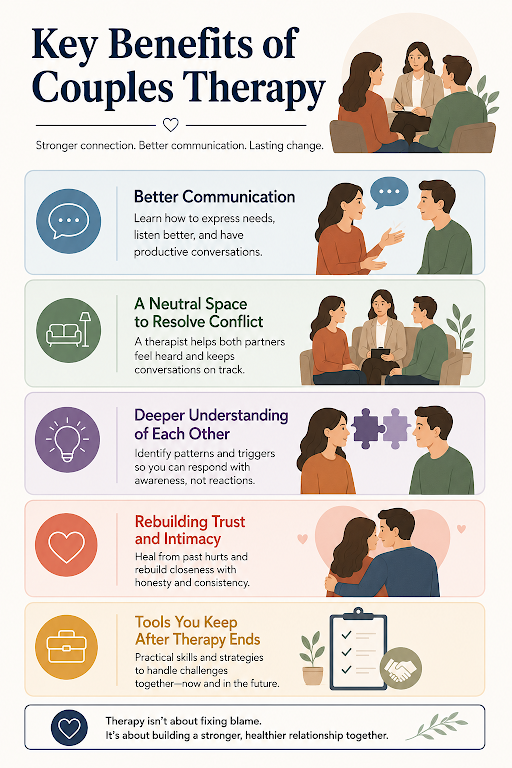
What actually changes in couples therapy isn’t always what people expect going in:
Better Communication Skills
Communication problems don’t always look like shouting matches. They show up as conversations that end before anything gets resolved, or topics that quietly get avoided because previous attempts felt pointless.
Therapy teaches partners how to express what they actually need, how to listen without immediately getting defensive, and how to time difficult conversations so they don’t spiral before they start.
A Neutral Space to Work Through Conflict
At home, arguments tend to follow the same path. One person escalates, the other shuts down, and nothing actually gets addressed.
A therapist doesn’t take sides. What they do is slow the conversation down enough that both partners can actually hear each other, something that’s surprisingly hard to do at home when the same argument has been running for months.
Deeper Understanding of Each Other
Therapy surfaces patterns that are hard to see from inside the relationship. One partner may not realize how their tone lands during conflict. The other may not recognize that they withdraw when they feel criticized rather than saying so directly.
Once those patterns become visible, both people are working with a clearer picture instead of reacting to what’s on the surface.
Rebuilding Trust and Intimacy
After infidelity, prolonged conflict, or emotional distance, trust doesn’t come back on its own. It requires consistent honesty, accountability, and time, but also a structured process for having the conversations that feel too charged to have without support.
Therapy creates that structure. And when the disconnection underneath gets worked through, closeness tends to come back on its own, not because it was forced, but because the thing blocking it finally got addressed.
Tools You Keep After Therapy Ends
The goal isn’t to need a therapist every time something goes wrong. It’s to leave with a clearer sense of how to handle it yourselves.
Couples who go through therapy often come out with specific communication habits, conflict repair strategies, and ways of checking in with each other that stay useful long after sessions end.
Read More Blog: Is It Love or Obligation?
Does Couples Therapy Actually Work?
Yes, and the research supports that. Studies consistently show that couples who commit to the process report measurable improvements in relationship satisfaction and communication.
The caveat is that both partners need to be genuinely engaged; therapy doesn’t work if one person is going through the motions while the other is doing the actual work.
The more common obstacle isn’t unwillingness; it’s timing. Couples tend to wait too long. By the time they book a first session, the same arguments have been happening for years, and the emotional distance has become the default.
Therapy works at that stage too, but it takes longer. The earlier couples go, the more options they have and the less ground they have to recover.
A lot of couples assume therapy is a last resort, something you try right before calling a lawyer. It’s not.
Couples who go proactively, before things get bad, tend to have an easier time because they’re building on something that still has momentum rather than trying to repair something that’s been strained for years.
Mental and Emotional Benefits of Couples Therapy
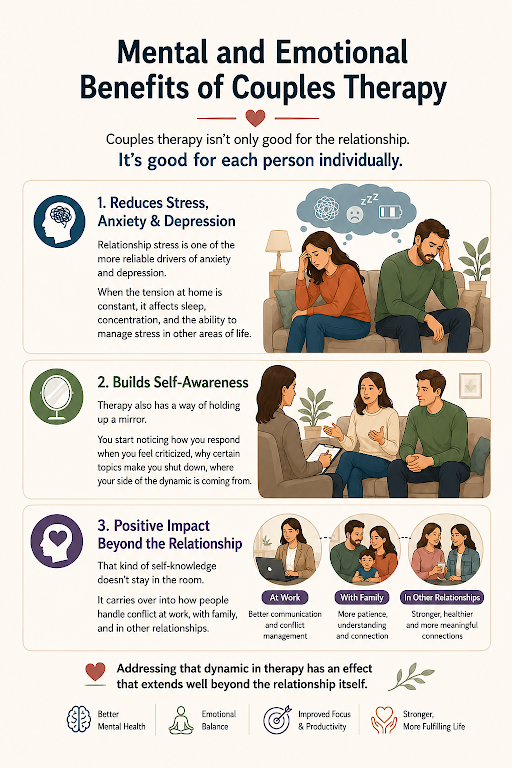
Couples therapy isn’t only good for the relationship. It’s good for each person individually. Relationship stress is one of the more reliable drivers of anxiety and depression.
When the tension at home is constant, it affects sleep, concentration, and the ability to manage stress in other areas of life. Addressing that tension in therapy often reduces symptoms that felt unrelated to the relationship.
Therapy also has a way of holding up a mirror. You start noticing how you respond when you feel criticized, why certain topics make you shut down, where your side of the dynamic is coming from.
That kind of self-knowledge doesn’t stay in the room. It carries over into how people handle conflict at work, with family, and in other relationships.
Addressing that dynamic in therapy has an effect that extends well beyond the relationship itself.
Read More Blog: What Is Family Therapy
Benefits of Couples Therapy Before Marriage
Premarital therapy isn’t a warning sign. It’s what happens when two people decide to have the harder conversations before life forces them to.
Couples who go to therapy before marriage get ahead of the conversations that tend to cause problems later: how they’ll handle finances, what their expectations are around family, how they each deal with conflict, and what intimacy looks like for each of them. These aren’t romantic topics, but they’re the ones that tend to create friction when they go unaddressed.
At Integrated Counseling Services, therapists work with couples at this stage the same way they work with couples navigating crisis, by looking at the specific dynamic between those two people rather than applying a generic framework.
The difference is that couples who go early are working with more goodwill and fewer entrenched patterns, which makes the process faster and the outcomes easier to maintain.
Going before marriage doesn’t prevent all problems. It does mean you’ve already practiced having the hard conversations before they arrive with higher stakes attached.
Who Should Consider Therapy for Couples?
A few situations where couples therapy tends to make a real difference:
Partners who keep having the same argument without resolution, where the topic changes but the outcome doesn’t. Couples who have drifted emotionally and aren’t sure when it started.
Relationships recovering from a breach of trust, an affair, or a period of prolonged conflict. Partners facing a major transition: a new baby, a career change, a move, where responsibilities have shifted, and neither person is sure how to adjust.
And couples who are doing well and want to stay that way, because waiting for a problem to appear before paying attention to the relationship is how small things become big ones.
What Are the 7-7-7 and 5-5-5 Rules in Couples Therapy?
The 7-7-7 rule is a relationship guideline suggesting couples go on a date every seven days, take a weekend away every seven weeks, and take a longer trip together every seven months. It’s not a clinical model, but the idea behind it is sound: relationships need regular investment, not just attention during a crisis.
The 5-5-5 rule is a structured communication exercise used in therapy. One partner speaks for five minutes without interruption. The other listens for five minutes without responding. The final five minutes are used to discuss what was heard. The goal isn’t to solve the problem immediately. It’s to slow the conversation down enough that both partners feel heard before any problem-solving begins.
Is Online Couples Counseling as Effective?
For couples who can’t easily get to in-person appointments because of scheduling, distance, or work commitments, online therapy is a practical alternative, not a lesser one.
Research shows that outcomes for online couples counseling are comparable to in-person sessions when both partners are engaged, and the therapist is experienced in the format.
The main advantage is accessibility. Couples are more likely to keep appointments when the barrier to showing up is lower, and consistency matters more in therapy than format.
What Couples Therapy Actually Looks Like
The first session is usually an assessment. The therapist gets a picture of the relationship, the patterns each partner has noticed, and what both people are hoping to change.
It’s not immediately confrontational; couples usually find the first session easier than they expected. Not every session feels productive in the moment. Some conversations open things up before they settle. That’s usually a sign something real is being worked through rather than avoided.
That’s normal and usually a sign that something real is being worked on rather than avoided. Couples typically start noticing changes in how they communicate at home within the first few weeks, even if the deeper work takes longer.
The length of therapy depends on what’s being addressed, and there’s no fixed rule for how long it takes. Some couples finish in a few months. Others come back periodically as their situation changes.
The goal isn’t to stay in therapy indefinitely. It’s to get to a point where the tools from therapy are doing the work instead.
If several of the patterns in this article sound familiar, that’s usually enough reason to start. Schedule a consultation to talk through what’s happening and what kind of support fits your situation.